


What Should a 1-Carat Lab-Grown Diamond Cost?
The price of a 1-carat lab-grown diamond averaged $559 USD in November 2026, based on more than 313,000 loose-stone listings. Prices ranged from about $275 to $1,411 USD as shape, cut, colour, and clarity changed. A 1-carat natural diamond averaged $3,828 USD in the same market data.
Use those figures as a starting point, not a quote for a finished ring. A setting and custom work add to the cost. At Inglis Jewellers, we help you look beyond the stone's price to the craftsmanship and support behind the piece.
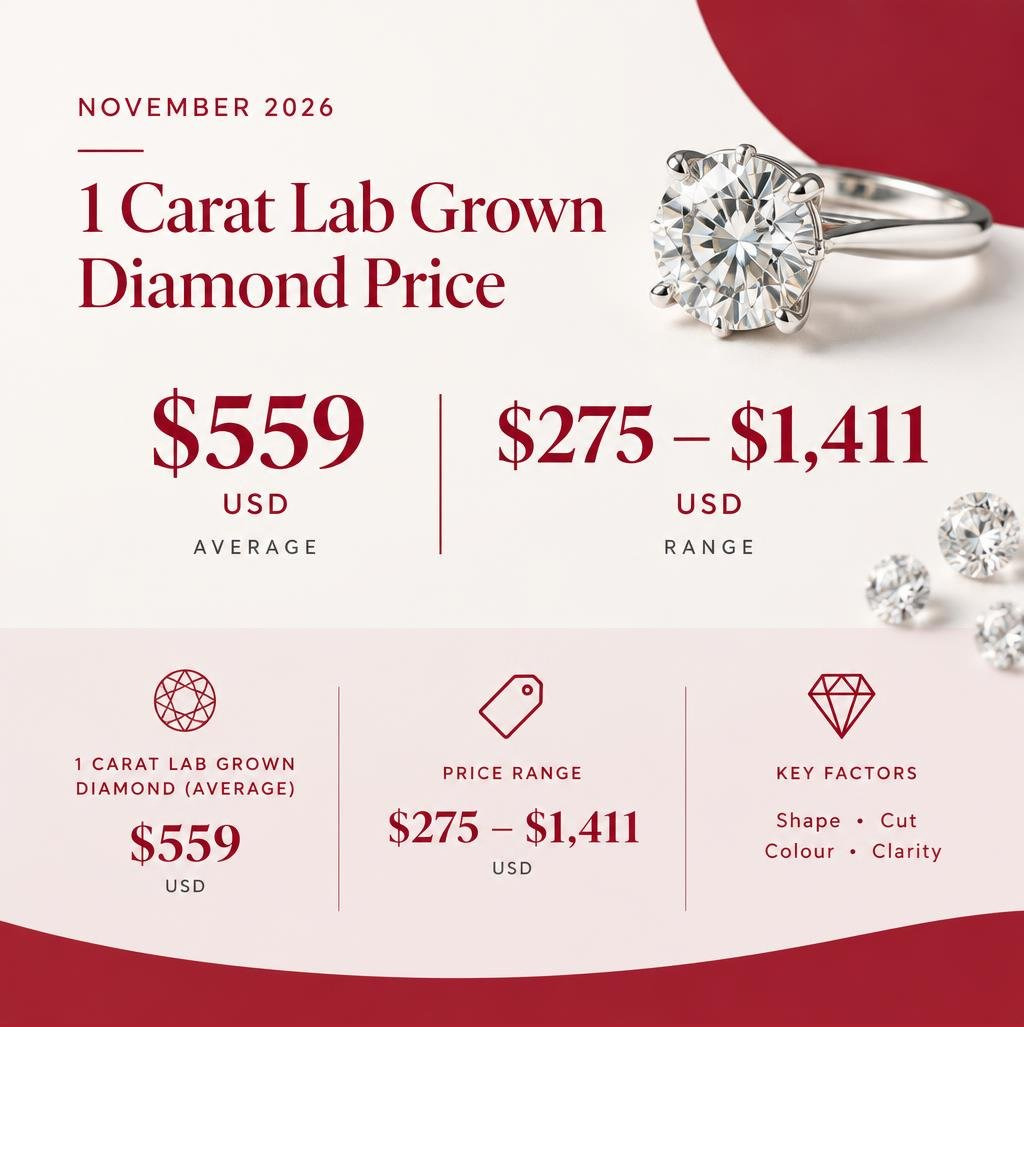
Current 1 Carat Lab Grown Diamonds Price Benchmarks for 2026
The market for lab-created stones is more active than ever. Tracking data across major diamond exchanges shows that the overall benchmark for a 1.00 to 1.24 carat lab-grown diamond hovers at an average price per carat of $657 USD. When looking strictly at 1.00-carat loose stones across all shapes and quality tiers, the average price sits comfortably at $559 USD.
If you are hunting for a classic round brilliant stone with premium specifications—specifically an E colour, VS1 clarity, Excellent cut diamond graded by the International Gemological Institute (IGI)—the market median benchmark lists at $544 USD. Depending on where you look, live retail listings for this exact grade combination range from $278 to $836 USD.
For shoppers looking to review broader pricing tiers across various diamond weights, our 1 ct diamond price guide 2026 offers an extensive breakdown of retail standards.
| Diamond Type (1.00 Carat) | Average Price (USD) | Typical Market Range (USD) | Active Market Listings Tracked |
|---|---|---|---|
| Lab Grown Diamond | $559 | $275 – $1,411 | 313,711 |
| Natural Mined Diamond | $3,828 | $2,100 – $8,500+ | 144,922 |
Data benchmarks provided by independent trackers, including the 1 Carat Lab Grown Diamond Price index, show that lab-grown inventories outnumber natural stone listings by more than two to one in the 1-carat category.
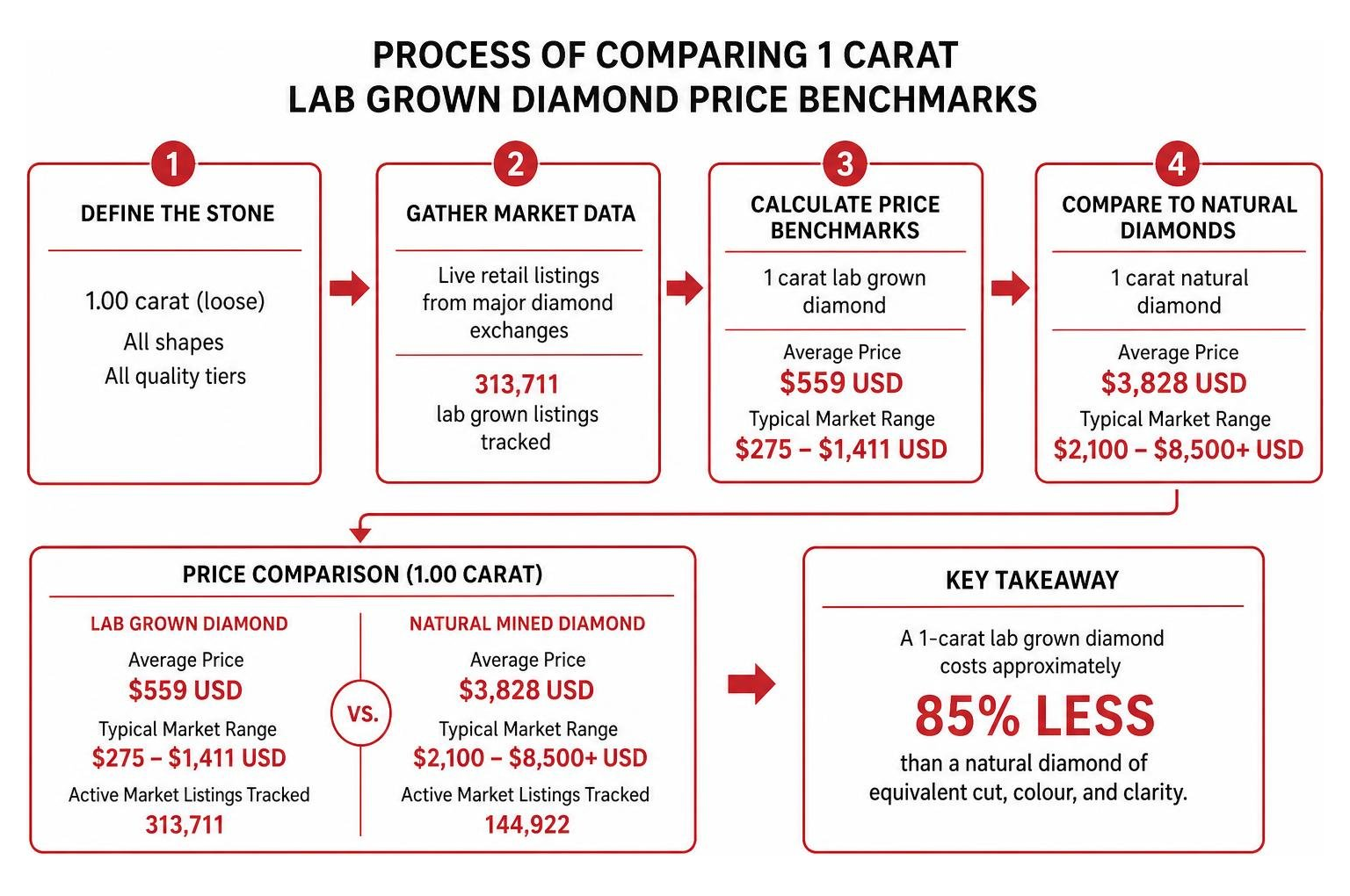
Lab Grown vs Natural Diamond Pricing Breakdown
The most striking takeaway for jewellery buyers is the immense price gap between manufactured and earth-mined gems. As of November 2026, a 1-carat lab-grown diamond costs approximately 85% less than a natural diamond of equivalent cut, colour, and clarity.
Natural diamonds require heavy earth-moving equipment, deep-crust excavation, and complex geopolitical supply chains that carry immense overhead costs. In contrast, lab-created diamonds are grown in advanced technological reactors using Chemical Vapour Deposition (CVD) or High Pressure High Temperature (HPHT) methods.
Because lab diamonds possess identical physical, chemical, and optical properties to mined diamonds, you receive the exact same crystal structure and fire without the steep mining premium. To explore the broader considerations when selecting fine gems, our diamond Canada buying guide 2026 breaks down every critical step.
Recent Market Fluctuations and Price Trends
While mined diamond pricing moves slowly (+0.21% over recent tracking periods), lab-grown diamond prices exhibit noticeable short-term movements. Over a 16-month historical window, round lab-grown diamond prices moved downward by -28.0% as production scaled across international cutting hubs.
Over the past 6 months, prices dipped -4.44%, while the past 3 months saw a rebound of +6.07%. Over a recent 30-day window, 1-carat lab diamond prices increased by 11.35% as available marketplace inventory contracted by 19.32% (a drop of 75,110 stones).
For monthly benchmark data, the Lab Grown Diamond Price Per Carat index tracks how supply tightening and consumer demand create these short-term pricing adjustments.
Price Breakdown by Diamond Shape and Cut Quality
Not all 1-carat diamonds cost the same amount to produce. The shape of a diamond directly influences its price per carat because different cutting styles yield different percentages of usable gem material from the original rough crystal.

When cutting a traditional round brilliant diamond, master cutters must polish away significant portions of the rough stone to achieve ideal symmetry and maximum brilliance. Fancy shapes like emerald cuts or oval cuts preserve a higher percentage of the rough crystal, which often translates to greater value per carat.
| Shape (1.00 Carat Lab Grown) | Average Price (USD) | Cutting Yield & Market Popularity |
|---|---|---|
| Radiant | $624 | High demand, intricate faceting |
| Marquise | $616 | Elongated outline, specialty cut |
| Pear | $593 | Vintage appeal, high brilliance |
| Cushion | $590 | Soft square profile, great light dispersion |
| Oval | $586 | High surface area spread, very popular |
| Asscher | $573 | Step-cut geometric square |
| Princess | $555 | Classic modern square cut |
| Heart | $542 | Complex specialty cutting process |
| Round | $534 | Highest waste during cutting, peak sparkle |
| Emerald | $512 | Clean step-cut, highest rough yield retention |
Average 1 Carat Lab Grown Diamonds Price by Shape
As shown in live aggregate data, the emerald cut represents the most accessible entry point at an average of $512 USD, while radiant and marquise cuts lead the upper tier at $624 USD and $616 USD respectively.
Marketplace listings from the Diamond Price Chart index confirm that fancy shapes offer varied price points based on market inventory levels and cutter supply.
Whether you prefer a sleek emerald cut or an elongated oval, we invite you to view our curated collection of lab grown diamonds for sale to find the cut that best matches your personal style.
How the 4Cs Impact the 1 Carat Lab Grown Diamonds Price
The classic 4Cs—Cut, Colour, Clarity, and Carat—remain the ultimate arbiters of a diamond's price tag.

- Cut Quality: Cut is the single most important factor determining sparkle and light return. An Ideal or Super Ideal cut carries a 10% to 15% premium over an average cut, but it ensures your stone never looks lifeless or dull.
- Colour Grading: For a 1.00 to 1.19 carat round stone, a top-tier D colour Flawless (FL) specimen averages $682 per carat, while a near-colourless G colour VS1 diamond averages around $299 per carat.
- Clarity Tiers: Eye-clean stones in the VS1 to VS2 clarity range deliver pristine visual appearance without the inflated cost of Flawless or Internally Flawless (IF) grades.
If you are exploring unique options beyond traditional white diamonds, our overview on fancy colored lab diamonds explores how colour saturation alters value. For a complete understanding of grading metrics, read our lab grown diamonds guide 2026.
Why Retailer Prices Vary for Identical Certified Diamonds
Have you ever found the exact same diamond certificate listed on two different websites with two completely different prices? This happens frequently across the online diamond industry.
Many online aggregate platforms do not own their inventory. Instead, they broadcast virtual diamond feeds drop-shipped directly from international cutting houses. One platform might add a modest markup, while another adds substantial retail overhead to cover expensive advertising campaigns.
Furthermore, dynamic pricing feeds updated on databases like Carat Hunter market data reflect changes in vendor margins, currency fluctuations, and temporary promotional discounts that can swing listed prices by over 30% overnight.
Certification Standards: IGI vs GIA
Independent diamond certification ensures that you receive the exact quality you pay for:
- IGI (International Gemological Institute): IGI is the industry standard for lab-grown diamonds, certifying the vast majority of lab stones on the global market with strict, reliable grading standards.
- GIA (Gemological Institute of America): GIA grades lab diamonds with precision, but GIA-certified lab stones often command a slight market price premium due to higher grading laboratory submission fees.
We strongly advise avoiding uncertified stones or stones with in-house proprietary grading cards, as they often overstate colour and clarity grades.
Price Scaling from 1 Carat to 1.5 and 2 Carat Stones
With natural diamonds, prices increase exponentially as carat weight rises because finding large, gem-quality rough in nature is exceptionally rare. With lab-created diamonds, pricing scales much more smoothly.
According to real-time listing benchmarks from The Diamond Price round directory:
- 1.0 Carat (E VS1 IGI Round): Market median is $544 USD.
- 1.5 Carat (E VS1 IGI Round): Market median is $672 USD.
- 2.0 Carat (E VS1 IGI Round): Market median is $1,156 USD.
Because scaling rough crystal in a reactor is a controlled scientific process, stepping up from a 1-carat to a 1.5-carat or 2-carat centre stone remains remarkably attainable. To plan out your complete ring budget effectively, consult our engagement rings Canada guide 2026.
Smart Strategies to Maximize Value on a 1 Carat Stone
Getting the best possible value on a 1-carat stone comes down to smart specification balancing.
- Target the Colour Sweet Spot (F–G): In face-up viewing, an F or G colour stone looks crisp, bright white to the naked eye while saving you hundreds over a D colour stone.
- Select Eye-Clean Clarity (VS1–VS2): Inclusions in VS1 and VS2 diamonds cannot be seen without a jeweller's 10x magnification loupe.
- Prioritize Excellent/Ideal Cut: Never compromise on cut. An excellently proportioned diamond reflects maximum light, making the stone appear brighter and often visually larger than poorly cut alternatives.
To explore responsibly produced options available locally, check our guide to man made diamonds Canada.
Evaluating Settings and Total Ring Mounting Costs
A loose diamond is only half of the finished piece. To calculate the true cost of an engagement ring or custom jewellery piece, you must factor in the setting:
- Classic Solitaire Mountings: Simple four-prong or six-prong bands in 14k white, yellow, or rose gold typically range from $400 to $900 CAD.
- Pavé & Halo Settings: Accentuated bands with pavé-set side diamonds or intricate halo mountings generally range from $800 to $1,800 CAD.
- Custom Goldsmithing & Platinum: Custom-designed rings or platinum settings require specialized bench craftsmanship, typically ranging from $1,200 to $2,500+ CAD depending on complexity.
At Inglis Jewellers, our in-house master goldsmiths handle setting, sizing, and custom design directly in our Atlantic Canada showrooms, ensuring your ring is built to last a lifetime.
Frequently Asked Questions About 1 Carat Lab Diamond Pricing
What is the average price of a 1 carat lab grown diamond?
As of November 2026, the average price of a 1-carat lab-grown diamond is $559 USD, with typical market listings ranging between $275 and $1,411 USD depending on cut quality, shape, colour, and clarity specifications.
Why are lab grown diamonds significantly more affordable than mined diamonds?
Lab-grown diamonds are produced in controlled laboratory facilities using advanced CVD and HPHT reactors. This scalable manufacturing process bypasses expensive heavy-earth excavation, resulting in loose stones that cost roughly 85% less than natural diamonds.
Are lab grown diamond prices expected to drop further in 2026?
While lab diamond prices experienced double-digit annual drops between 2022 and 2024, recent data indicates that pricing is stabilizing. With wholesale manufacturing costs reaching baseline operational floors and steady consumer demand, future price movements are expected to be modest.
Conclusion
Understanding live market data is the best way to ensure you never overpay for your jewellery. With 1-carat lab-grown diamonds averaging around $559 USD, you can secure a breathtaking, top-quality centre stone at a fraction of the cost of a mined diamond.
To understand the complete breakdown of diamond pricing dynamics, explore our comprehensive guide on the cost of lab grown diamonds.
Whether you are shopping online or visiting our teams in Truro, New Glasgow, Sydney, or Riverview, Inglis Jewellers is here to combine transparent pricing with unmatched local goldsmithing craftsmanship.