


Lab Grown vs Mined Diamonds: What Matters Most?
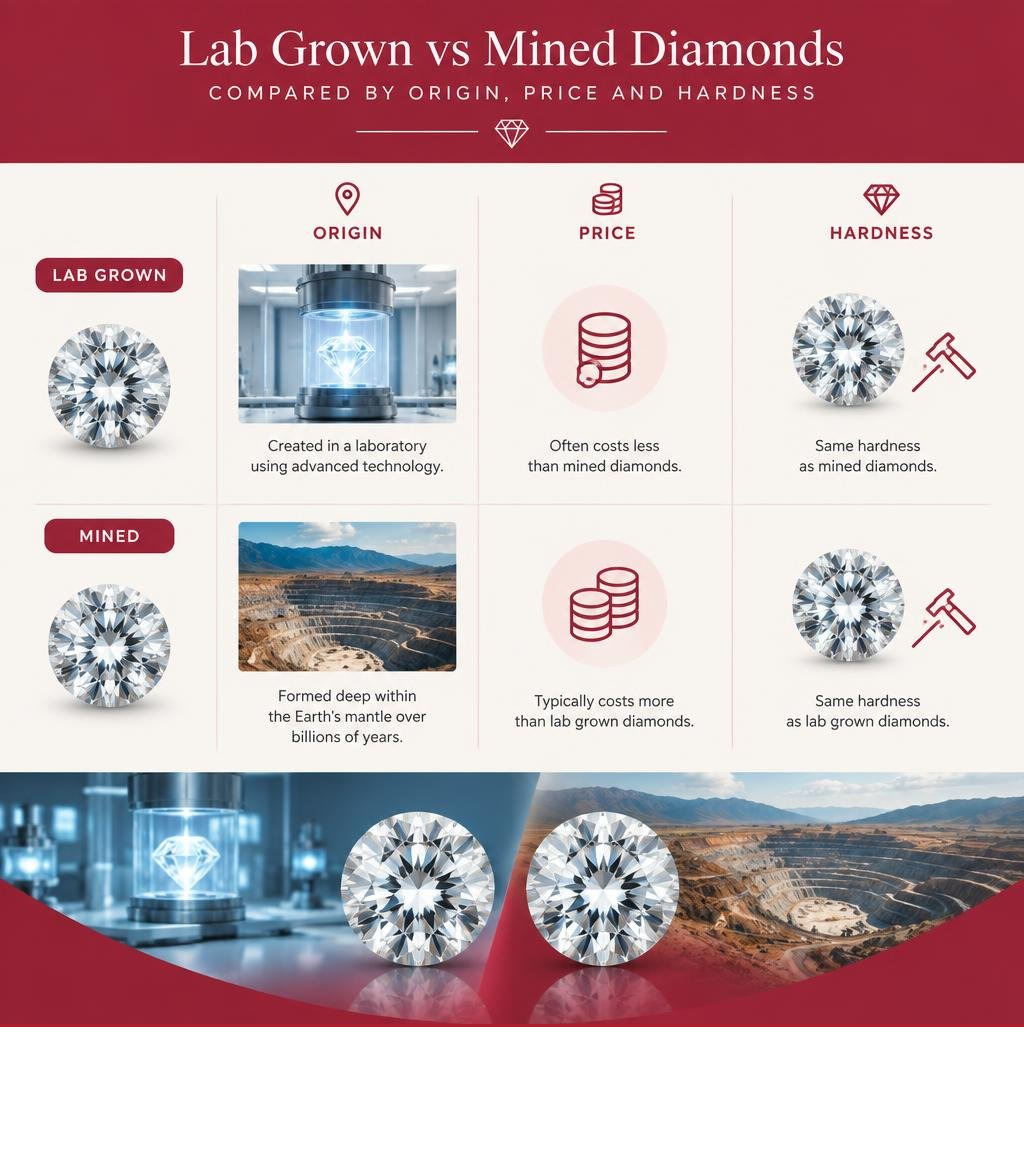
Lab grown diamonds are real diamonds. They are made from carbon in a controlled setting rather than formed deep underground. They have the same hardness and sparkle as mined diamonds, but they often cost less. The main differences are origin, price, and sourcing, not whether the stone is a diamond.
For a ring you plan to wear for years, compare the cut, colour, clarity, and carat weight of each stone. Ask for an independent grading report, then check the jeweller's return, resizing, and warranty terms before you buy. At Inglis Jewellers, we believe those details should be as clear as the diamond itself.
Understanding Lab Grown Diamonds: Creation, Science, and Quality
To truly understand modern diamonds, we have to look closely at the science of crystal growth. Mined diamonds form billions of years ago under extreme heat and pressure deep within the Earth's mantle before being brought to the surface by volcanic activity. In contrast, created stones begin with a thin sliver of carbon—known as a diamond seed—placed inside an advanced laboratory environment.
Two primary methods recreate these natural forces:
- High Pressure High Temperature (HPHT): This method replicates the intense geological conditions of the Earth's mantle. The diamond seed is placed in a mechanical press and subjected to pressures exceeding 50,000 atmospheres and temperatures above 1,400°C, causing pure carbon to melt and crystallize around the seed.
- Chemical Vapour Deposition (CVD): This technique involves placing a seed crystal into a vacuum chamber filled with carbon-rich gases (such as methane). Using microwave beams, the gas is heated into a plasma state, breaking down the molecular bonds and allowing pure carbon atoms to deposit layer by layer onto the diamond seed.
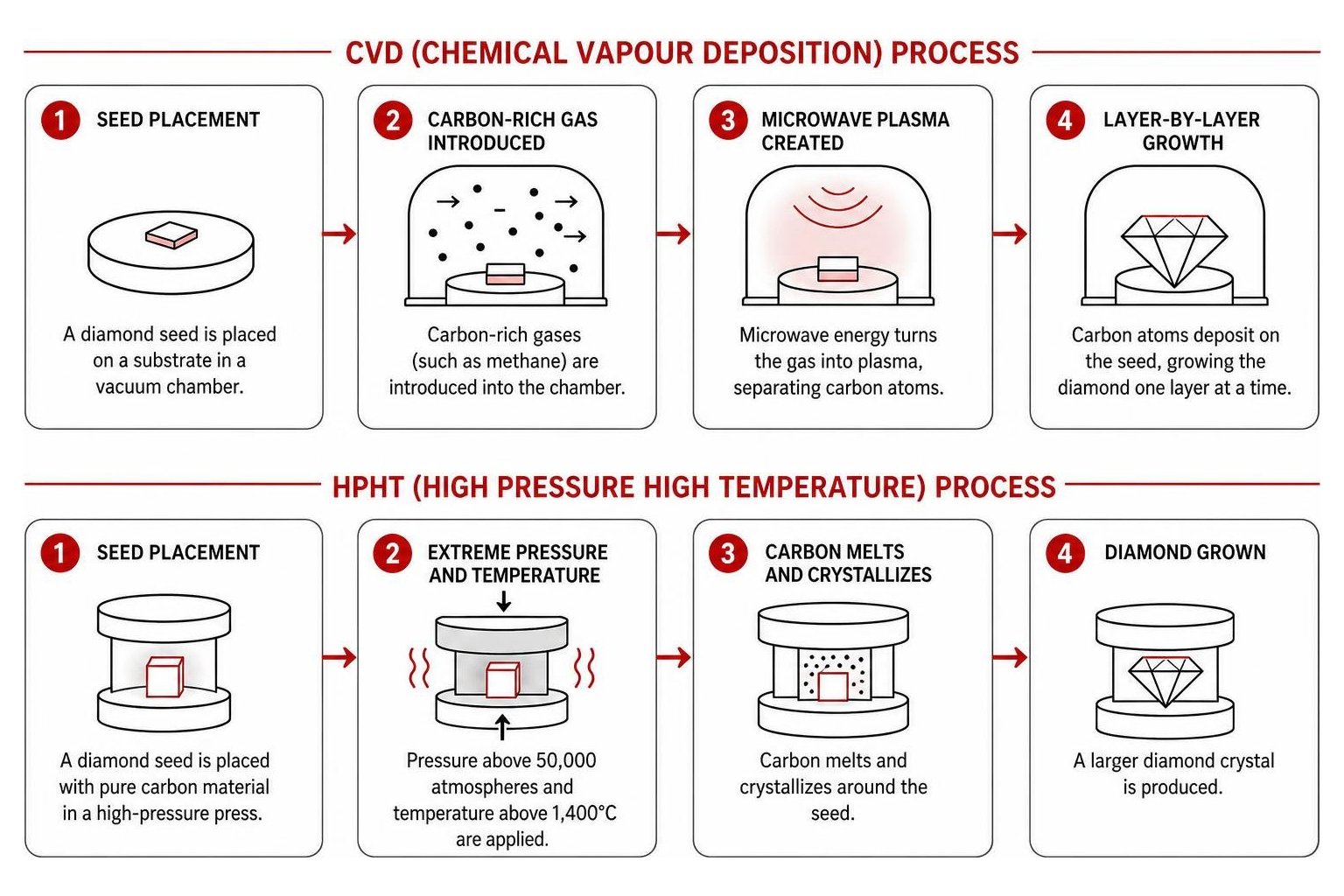
Both processes produce a pure, crystalline carbon lattice identical to that of a mined stone. Readers curious about the science behind these stones can learn more about man-made diamonds in Canada to see how cutting-edge methods shape fine jewellery today.
Just like geological gems, every lab diamond is evaluated using the classic 4Cs: Cut, Colour, Clarity, and Carat weight. Independent gemmological bodies, including the International Gemological Institute (IGI), evaluate each gem using the exact same grading criteria and precision equipment.
How Lab Grown Diamonds Compare to Mined Diamonds
When you look at a laboratory-grown diamond and a mined diamond side by side, there is zero visual difference. Because both stones share an identical cubic crystalline form, they possess the exact same refractive index (2.42), fire, dispersion, and thermal conductivity. They both score a perfect 10 on the Mohs Scale of Hardness, making them the hardest known mineral on the planet.
| Feature | Lab Grown Diamonds | Mined Diamonds |
|---|---|---|
| Chemical Composition | Pure crystallized carbon (C) | Pure crystallized carbon (C) |
| Mohs Hardness | 10 (Maximum durability) | 10 (Maximum durability) |
| Refractive Index | 2.42 (Identical sparkle) | 2.42 (Identical sparkle) |
| Price Difference | Up to 80% lower cost | Traditional premium pricing |
| Origin | Advanced laboratory chamber | Earth's mantle extraction |
| Grading Standards | Certified by IGI & GIA (4Cs) | Certified by IGI & GIA (4Cs) |
If you are weighing your choices between these two origins, take a moment to read our breakdown comparing natural vs lab grown diamonds to see which fits your personal philosophy and lifestyle best.
Color Variety and Fancy Colored Options
Natural fancy coloured diamonds are extraordinarily rare geological occurrences, often fetching millions at auction due to trace elements trapped during crystal formation. In a controlled laboratory setting, master technicians introduce specific elemental gases during the growth phase to create breathtaking colours with remarkable consistency.
- Fancy Vivid Pink: Created by introducing precise crystal lattice distortions (plastic deformation) during growth.
- Canary Yellow: Achieved through controlled levels of nitrogen atoms interspersed in the carbon grid.
- Vivid Blue: Formed by adding trace amounts of the element boron into the growth chamber.
To see how these vibrant stones can elevate modern custom designs, explore our showcase of fancy coloured lab diamonds.
Cost Comparison: Pricing Differences and Budget Benefits
One of the most practical advantages of modern diamond creation is affordability. Lab grown diamonds can cost up to 80% less than mined stones of identical cut, colour, clarity, and carat weight.
This significant price reduction is not due to inferior quality; rather, it reflects a streamlined, modern supply chain. Traditional diamond mining requires massive capital expenditure, earthmoving equipment, extensive global shipping networks, and layers of middle-tier broker markups. Modern synthesis takes weeks instead of millennia, eliminating many of these logistical layers.
For couples planning a proposal, this price efficiency allows you to optimize your budget. You can choose a noticeably larger carat weight, select an exquisite cut grade, or invest in a heavier, custom-designed precious metal setting without exceeding your financial comfort zone. You can discover breathtaking possibilities across our curated collection of lab-grown diamond engagement rings, or review our detailed guide on the cost of lab grown diamonds to see how far your budget can stretch.
Sustainability and Ethical Advantages
Modern fine jewellery buyers place deep value on knowing the exact origins of their luxury pieces. Because laboratory stones are created in dedicated technological facilities, their chain of custody is straightforward and verifiable from the moment of synthesis.
- Conflict-Free by Design: These stones avoid the historical regional disputes associated with unregulated earth extraction.
- Zero Child Labour: Production happens in strictly regulated laboratory facilities with professional staff.
- Minimal Surface Displacement: Creating stones indoors avoids open-pit mining operations and ecological disruption.
- Resource Efficiency: Modern production facilities increasingly rely on renewable power grids, helping lower the overall footprint per carat.
Advanced structural studies, such as published research on molecular synthesis structures, highlight how tightly controlled laboratory environments allow scientists to understand and manipulate complex molecular systems with extreme precision. In fine jewellery, that exactness provides consumers with ethical peace of mind alongside exceptional sparkle.
What to Look for When Choosing a Diamond Specialist
Whether you prefer shopping locally or ordering online, selecting the right jeweller is just as essential as choosing the right stone. A reputable diamond specialist should offer clear policies, transparent grading, and master craftsmanship.
When evaluating a jeweller, look for:
- Independent Gemmological Certification: Always ensure the centre stone includes a grading report from an established laboratory, such as the IGI.
- Comprehensive Warranties & Return Windows: Look for clear guarantees, lifetime manufacturing warranties, and risk-free inspection windows (such as a 30-day return policy).
- Complimentary Resizing & Care: A dedicated jeweller should provide maintenance, complimentary initial ring resizing, and professional cleaning services.
- In-House Goldsmithing: Retailers with experienced in-house goldsmiths can craft bespoke mountings, perform repairs on-site, and customize every tiny detail of your ring.
Shopping for Lab Grown Diamonds in Showrooms vs Online
While online shopping provides convenient browsing, viewing diamonds in person allows you to experience their fire, brilliance, and scintillation under various lighting conditions.
At Inglis Jewellers, we bridge the convenience of online shopping with the confidence of our Atlantic Canada showrooms in Truro, New Glasgow, Riverview, and Sydney. Whether you drop by to inspect loose diamonds under a microscope or schedule a personalized virtual bridal consultation, our experienced goldsmiths and jewellery consultants will guide you through every setting and stone option. You can comfortably browse lab grown engagement rings online or consult with our team to create a completely custom heirloom.
Frequently Asked Questions About Diamond Selection
Do lab created diamonds hold up over a lifetime of everyday wear?
Yes. Because they possess the exact same cubic carbon crystal structure as mined diamonds, they measure a 10 on the Mohs Scale of Hardness. They resist scratching, chipping, and daily abrasion just as effectively as natural stones, making them ideal for lifetime heirloom rings and everyday wear.
Can standard jewellery tests distinguish between lab created and mined stones?
No. Standard diamond testers that measure thermal and electrical conductivity will register a lab grown diamond as a genuine diamond because its physical properties are identical. Distinguishing between them requires specialized laboratory spectroscopy equipment that examines microscopic growth patterns and laser-inscribed girdle serial numbers.
What guarantees and grading documentation should accompany a diamond?
Your diamond should always arrive with an independent certificate from a recognized gemmological institute like the IGI. This report verifies the 4Cs, confirms the stone's origin, and matches the unique serial number inscribed microscopically onto the diamond's edge.
Conclusion
Choosing between a lab created and a mined diamond ultimately comes down to your personal values, style preferences, and budget goals. Both paths provide authentic diamond beauty, world-class hardness, and timeless elegance.
At Inglis Jewellers, we take pride in offering handcrafted fine jewellery, conscious bridal options, and custom goldsmithing across Nova Scotia and New Brunswick. If you are ready to begin your design journey, we invite you to explore detailed pricing and cost of lab grown diamonds or visit one of our friendly showrooms today.