


How to Shop for Certified Lab-Grown Diamonds Online
When browsing lab-grown diamonds for sale, start with an independent grading report from a lab such as IGI or GIA. Check that its report number matches the diamond, then compare cut, color, clarity, and carat weight across stones. Before you pay, confirm the total price, insured shipping, and return terms.
A lab-grown diamond is a real diamond. Its beauty and durability make it a practical choice for an engagement ring or everyday jewellery, but a good grade alone does not tell you whether an online purchase is right for you. At Inglis Jewellers, we want you to know what to inspect before you choose. For broader context on how these stones are produced and graded, the International Gemological Institute offers independent educational resources on lab-grown diamond certification.

Understanding Creation, Quality, and Durability: Lab vs. Natural Diamonds
To evaluate these gems properly, it helps to understand what happens inside the growth chamber. Scientists create diamonds using two primary advanced methods: High Pressure High Temperature (HPHT) and Chemical Vapor Deposition (CVD).
- HPHT (High Pressure High Temperature): Replicates the intense geological forces found deep within the Earth's mantle, subjecting a refined carbon seed to temperatures exceeding 1,400 degrees Celsius and extreme pressures around 1.5 million pounds per square inch.
- CVD (Chemical Vapor Deposition): Places a sliver of diamond seed inside a vacuum chamber filled with carbon-rich gases (such as methane and hydrogen), ionizing the gas into plasma to deposit pure carbon atom-by-atom onto the seed crystal lattice.
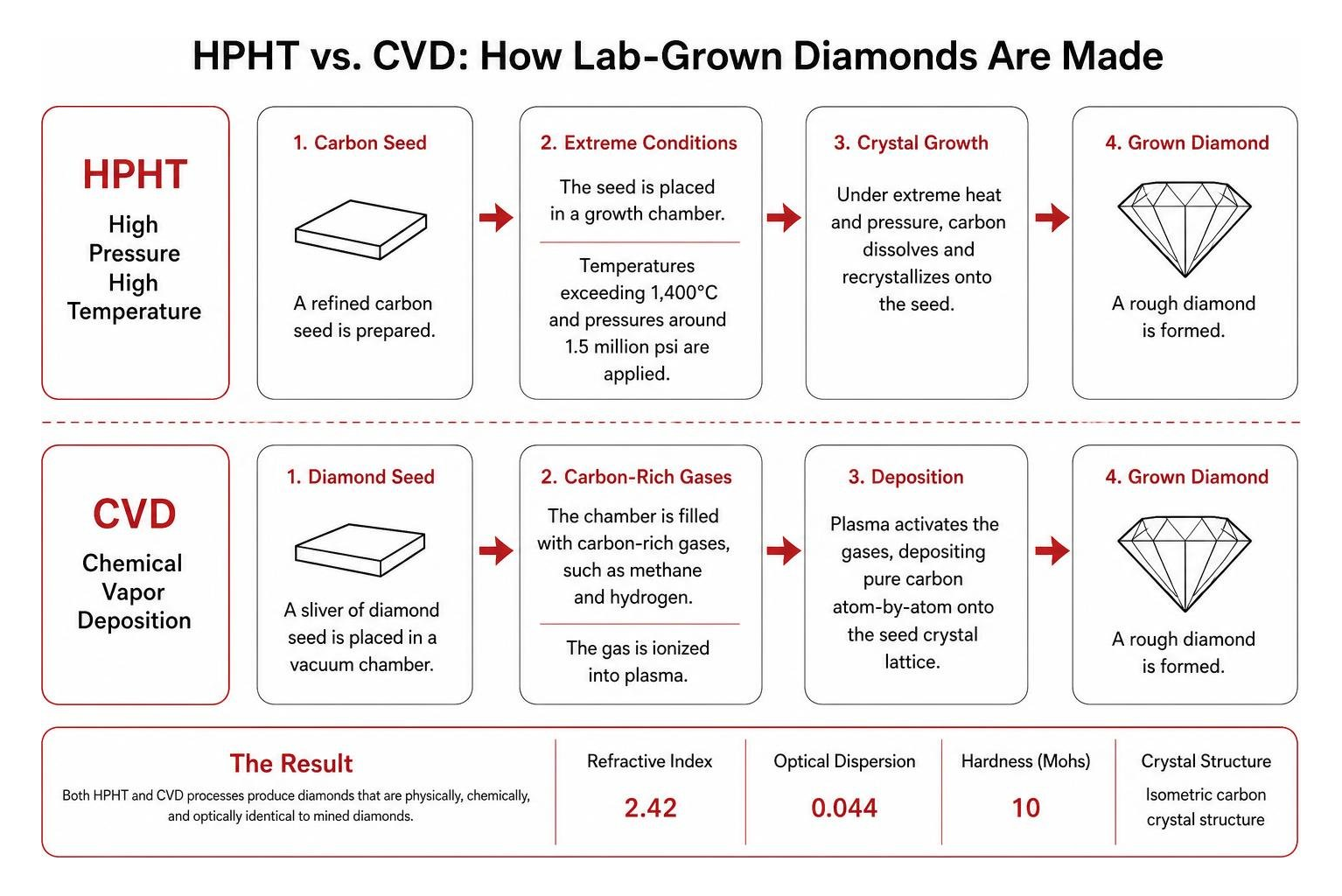
Both processes produce a mineral that is physically, chemically, and optically identical to mined stones. Evaluating natural vs lab grown diamonds reveals that both share an isometric carbon crystal structure, identical light refraction (refractive index of 2.42), identical fire (optical dispersion of 0.044), and a hardness score of 10 on the Mohs scale.
| Property | Natural Mined Diamond | Lab-Grown Diamond |
|---|---|---|
| Chemical Composition | Pure Carbon ($C$) | Pure Carbon ($C$) |
| Mohs Hardness Scale | 10 out of 10 | 10 out of 10 |
| Refractive Index (Brilliance) | 2.42 | 2.42 |
| Optical Dispersion (Fire) | 0.044 | 0.044 |
| Relative Price Difference | Higher baseline cost | Up to 70–80% lower per carat |
Because lab diamonds possess identical structural resilience, you can wear them every single day without fear of dulling or clouding over time.
Ecological Impact and Ethical Integrity of Lab Created Stones
A major reason modern couples look for lab-created gems is their responsible origin. Traditional diamond mining requires excavating thousands of tons of earth, which disrupts local habitats and consumes substantial fuel and water.
In contrast, our man made diamonds Canada guide highlights how laboratory cultivation bypasses open-pit mining entirely. Creating stones in controlled facilities avoids environmental habitat destruction, offers fully traceable origins, and significantly lowers the overall carbon footprint per carat.
Everyday Wear and Astrological Suitability
A frequent question we hear across our showrooms is whether lab-created gems hold up to daily life. Scoring a perfect 10 on the Mohs scale—the hardest mineral known—lab stones are scratch-proof against everyday abrasions. They represent the classic April birthstone with complete physical authenticity.
For those interested in Vedic astrology and planetary energies, opinions vary: traditional purists lean toward naturally mined stones formed over billions of years, while modern gem enthusiasts celebrate the crystalline purity and conflict-free harmony of lab stones. Our foundational diamond education resources explore these nuances so you can pick what feels best for your personal values.
Key Specifications of Lab-Grown Diamonds for Sale: The 4 Cs and Fancy Shapes

Grading lab gems follows the exact same 4 Cs established for earth-mined diamonds:
- Cut: The most important factor for sparkle. An excellent or ideal cut directs light internally through the facets, returning maximum fire and brilliance to the eye.
- Color: Evaluated from D (completely colorless) down to Z (light yellow or brown tint). Grades from D through F offer icy perfection, while G through J provide near-colorless beauty at exceptional value.
- Clarity: Assesses internal inclusions or external blemishes under 10x magnification, ranging from Flawless (FL) to Included (I1–I3). Grades like VS1 or VS2 offer an "eye-clean" appearance where natural growth characteristics remain invisible without a microscope.
- Carat Weight: Measures physical weight (1 carat = 0.20 grams). To master how these factors interact, explore our diamond rings guide 2026 for comprehensive grading insights.
Verifying Certification on Loose Lab-Grown Diamonds for Sale
Never purchase a loose diamond online without an independent grading report from an internationally recognized gemological institute, such as the International Gemological Institute (IGI) or the Gemological Institute of America (GIA).
Reputable growers ensure stones receive a microscopic laser inscription on the girdle containing the grading report number and a notation like "LG" or "LABGROWN." When buying online, match the numerical inscription against the digital registry using the grading lab's official online portal.
Diamond Cut Geometries and Carat Size Possibilities
Modern technological advancements allow growers to produce rough crystals exceeding 5 carats regularly, with record-breaking experimental stones produced over 150 carats. This versatility opens the door to dazzling fancy shapes:
- Elongated oval cut gemstones that flatter the hand and maximize surface area.
- Sophisticated emerald cut engagement settings that highlight crystal clarity with sleek step-cut facets.
- Timeless round shaped engagement rings that offer unmatched light return and brilliance.
Fancy Colored Diamond Varieties
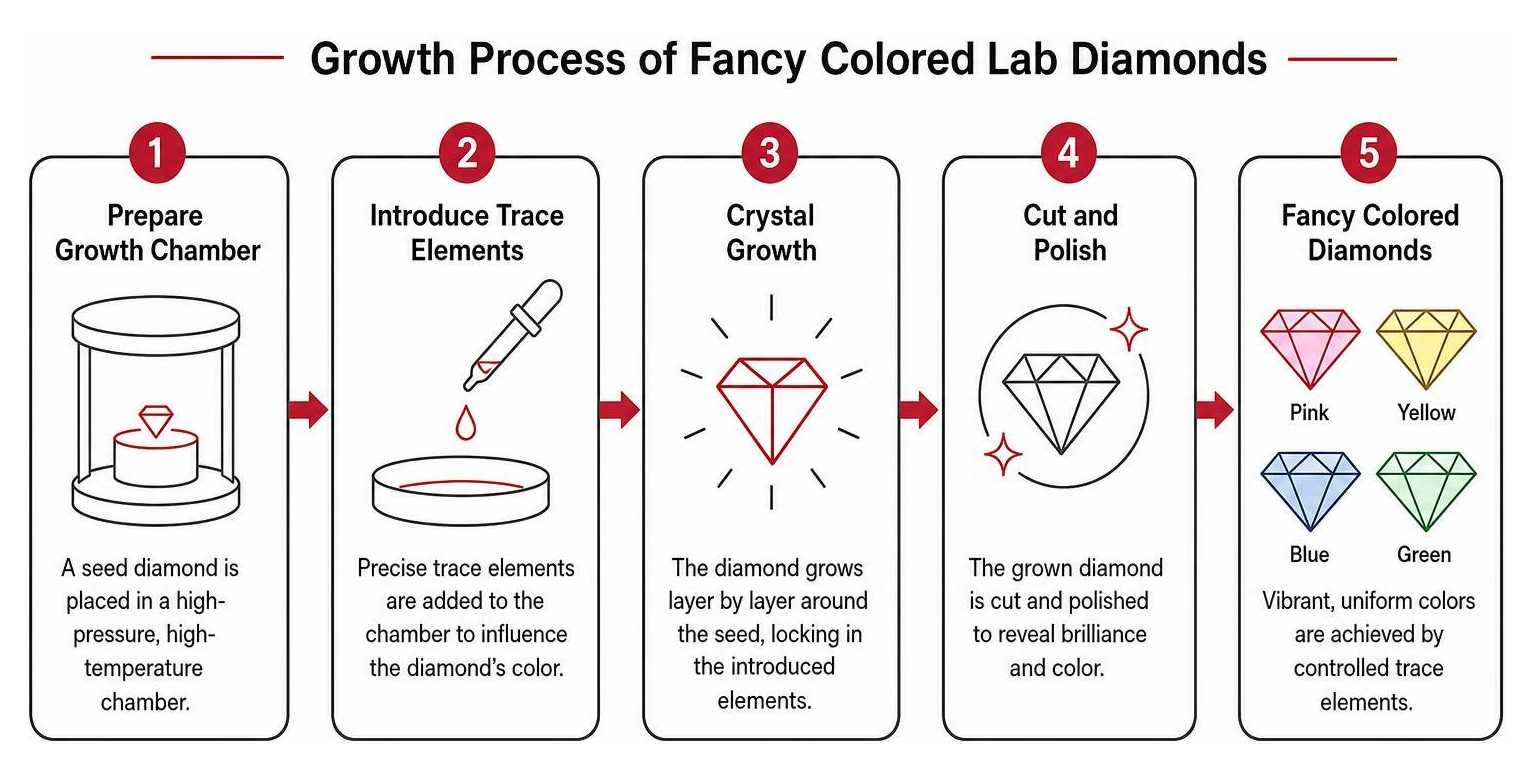
Natural fancy-colored diamonds are among the rarest gems on Earth, commanding astronomical prices. Lab technology introduces precise trace elements into the growth chamber—such as boron for deep blues or nitrogen for vivid yellows—creating radiant, uniform colors.
Our overview on fancy colored lab diamonds showcases stunning possibilities, from vivid pinks to striking canary yellows, making breathtaking statement jewellery accessible.
Pricing Structures, Metal Pairings, and Modern Jewelry Setting Trends
A certified lab-grown diamond pairs effortlessly with fine precious metals:
- Platinum: Hypoallergenic and naturally bright white, platinum provides secure prong retention and enhances colorless (D–F) diamonds.
- 14k & 18k White Gold: Offers a crisp, cool mirror finish that complements geometric silhouettes and vintage styles.
- 14k & 18k Yellow Gold: Warm, classic, and rich, yellow gold provides a striking contrast that flatters near-colorless center stones (G–I).
- Rose Gold: Delivers a romantic, vintage warmth that pairs beautifully with warm or blush-toned gems.
These combinations shine across modern designs detailed in our engagement rings Canada guide 2026 as well as classic daily pieces like fine tennis bracelets.
Comparing Online Prices on Lab-Grown Diamonds for Sale
When searching online, evaluate both the total retail price and the calculated per-carat price. A typical 1.90-carat round diamond graded G color and VS2 clarity frequently retails online around $750, while an extraordinary 2.58-carat Fancy Vivid Blue oval diamond (VS1 clarity) can be found near $1,420. By comparison, natural counterparts with identical visual qualities command tens of thousands of dollars.
Be sure to account for extra costs such as shipping insurance, custom duties, mounting fees, and setting labour to evaluate the true final investment.
Trending Setting Styles for Lab-Created Stones
Because lab diamonds free up budget flexibility, couples are choosing distinct, creative settings:
- Solitaire Bands: Clean, minimalist bands that keep all eyes on the center diamond's proportions.
- Hidden Halo Engagement Rings: A delicate circle of diamonds tucked beneath the center stone's gallery for subtle sparkle from every profile angle.
- Three Stone Engagement Rings: Featuring side stones that frame the center gem, symbolizing a couple's past, present, and future.
- East West Engagement Rings: Setting fancy shapes horizontally across the finger for a modern, architectural look.
Buyer Protection: Logistics, Financing, and Vetting Reputable Online Sellers
Buying fine jewellery online requires total confidence. Before entering payment details, inspect these key seller policies:
- Insured Shipping Logistics: Ensure the seller uses fully insured courier transit requiring an adult signature upon delivery.
- Flexible Financing & Layaway: Look for transparent payment terms, installment financing, or layaway plans that fit your lifestyle.
- Return Guarantees: Reputable retailers provide a transparent return window (such as 30 days) with no restocking fees.
- Artisan Goldsmith Services: True longevity comes from working with established professionals who can size, maintain, and inspect your ring over time.
At Inglis Jewellers, we take pride in crafting custom engagement rings in Atlantic Canada and backing our fine pieces with our dedicated lifetime diamond promise.
Frequently Asked Questions about Buying Lab Diamonds Online
How can I verify that a lab-grown diamond is authentic and certified?
Verify authenticity by checking the physical grading certificate against the issuer's online database (such as IGI or GIA). A professional jeweller can also inspect the diamond's girdle under magnification to locate the laser-inscribed certificate number.
Are lab-grown diamonds durable enough for everyday engagement rings?
Yes. Lab-grown diamonds rate 10 out of 10 on the Mohs scale of mineral hardness, matching mined diamonds in hardness, structural durability, and resistance to scratches.
How does the cost of a lab-grown diamond compare to a mined diamond?
Lab-grown diamonds typically cost 70% to 80% less than mined diamonds of equivalent cut, color, clarity, and carat weight, allowing buyers to select larger carat weights or higher clarity grades within the same budget.
Conclusion
Shopping online for lab-grown gems gives you remarkable freedom, brilliance, and value. By focusing on certified grading reports, evaluating the 4 Cs, choosing quality metal settings, and partnering with experienced goldsmiths, you can select an extraordinary diamond with complete confidence.
Ready to discover your ideal stone? Explore the detailed cost of lab-grown diamonds or connect with our team at Inglis Jewellers across Truro, New Glasgow, Sydney, and Riverview to start designing your custom piece.