


What You Need to Know About Antique Cameo Appraisal
Getting an antique cameo appraisal right comes down to five things: material, carving quality, setting, condition, and provenance. Here is a quick summary before we dive deeper:
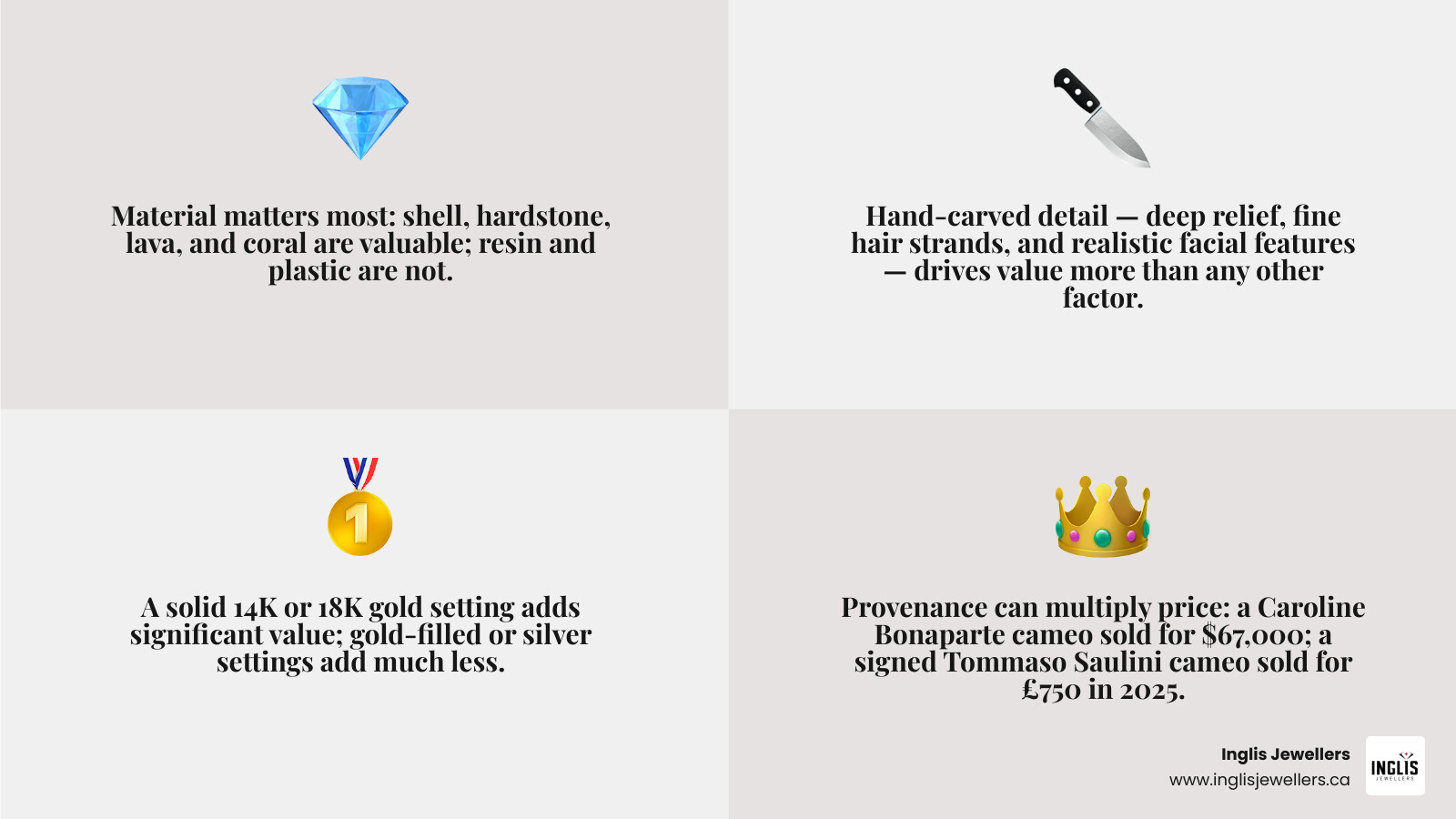
- Material — Shell, hardstone, lava, and coral are the most valuable. Resin and plastic are not.
- Carving quality — Hand-carved detail (deep relief, fine hair strands, realistic facial features) drives value more than almost anything else.
- Setting — A solid 14K or 18K gold frame adds significant value. Gold-filled or silver settings add less.
- Condition — Hairline cracks and chips reduce value. Major breaks through the face reduce it sharply.
- Provenance — A signed piece, royal connection, or documented history can multiply the price dramatically. A cameo made for Caroline Bonaparte sold for $67,000 in 2015. A signed Tommaso Saulini shell cameo sold for £750 as recently as February 2025.
The gap between a $25 costume piece and a $4,000 heirloom often comes down to details most people overlook — the curve on the back of the shell, the depth of a carved cheek, a tiny hallmark stamped into the mount.
This guide walks you through every step, from identifying your cameo's material to photographing it for a professional valuation.
At Inglis Jewellers, we work with clients across Atlantic Canada to evaluate, repair, and appraise antique jewelry — and we have put together this guide to help you understand exactly what makes your cameo valuable before you seek a formal assessment.
Identifying Cameo Materials: Shell, Hardstone, Lava, and Resin
To accurately begin an antique cameo appraisal, you must first determine the substrate material. Historically, artisans carved cameos using natural materials with distinct layers of contrasting color. This technique, known as a due strati (two layers), relies on the carver cutting through a lighter upper layer to reveal a darker background layer.
How can you tell what your family heirloom is made of? Let's break down the four most common materials:
1. Shell Cameos
Shell is the most common material used in Victorian and Edwardian jewelry. Typically carved from marine bivalves like the carnelian shell (which yields a warm orange-peach background) or the sardonyx shell (yielding a deep brownish-red background), these pieces are lightweight and relatively thin.
- The Translucency Test: Hold the cameo up to a light source. Genuine shell will show gentle translucency, and you will often see faint, natural growth striations running horizontally through the material.
- The Curve Check: Run your finger along the back of an unset or open-backed cameo. Because shells are naturally curved, the back of a genuine shell cameo will have a slight, natural concave curvature.
2. Hardstone Cameos
Hardstone cameos—typically carved from agate, onyx, sardonyx, or chalcedony—are highly prized. Because these stones are incredibly hard, carving them required immense skill, specialized tools, and hours of patient labor.
- The Temperature Test: Hardstone is a natural thermal conductor. If you touch a hardstone cameo to your cheek or the tip of your tongue, it will feel instantly ice-cold and take several seconds to warm up. Plastic, glass, and resin will feel warm or neutral right away.
- Visual Texture: Hardstone features a highly polished, glassy, or semi-matte finish with sharp, incredibly crisp boundaries between the color layers. Unlike shell, the back of a hardstone cameo will be completely flat and smooth.
3. Lava Cameos
Popularized during the "Grand Tour" era of the 18th and 19th centuries, when wealthy young aristocrats traveled across Europe, lava cameos were carved from soft volcanic tuff sourced near Mount Vesuvius in Italy. Contrary to the name, they are not made of literal molten lava glass, but rather a dense, easily carvable volcanic clay.
- Physical Traits: Lava cameos have a very distinct matte, porous surface and come in earthy tones—olive, terracotta, chocolate brown, and charcoal grey. They are deeply carved, often featuring high-relief, three-dimensional portraits.
4. Resin and Plastic Imitations
As costume jewelry exploded in popularity during the 1930s and 1940s, manufacturers began molding "cameos" from celluloid, Bakelite, and eventually modern plastics or resins.
- Weight and Feel: These pieces feel incredibly light, warm to the touch, and lack the cool heft of stone or the delicate, organic feel of shell.
- The Magnification Test: Under a jeweler's loupe, a molded resin cameo will reveal tiny micro-bubbles, perfectly uniform surfaces, and faint mold lines along the edges where the two halves of the manufacturing press met.
To help you quickly categorize your piece, we have summarized these material characteristics below:
| Material | Background Colors | Surface Texture | Back Shape | Temperature Feel |
|---|---|---|---|---|
| Shell | Orange, peach, dark brown | Matte to soft sheen, faint growth lines | Concave (curved) | Warm/Neutral |
| Hardstone | Black, dark brown, grey, green | Glassy, highly polished, crisp lines | Flat | Ice-cold |
| Lava | Olive, grey, tan, brown | Matte, highly porous, very deep relief | Flat | Neutral |
| Resin / Plastic | Uniformly colored, any shade | Shiny, uniform, no tool marks | Flat and glossy | Warm |
Key Factors in an Antique Cameo Appraisal
When we conduct an antique cameo appraisal at our locations in Nova Scotia and New Brunswick, we look past mere age. There is no rule that says a cameo is valuable simply because it is old; instead, we evaluate the piece using a structured framework of value drivers.
For a deeper look into how these elements interact, you can read more about evaluating your piece in From Family Heirloom to Auction Gold: Is Your Cameo Worth a Fortune? | by Lopa Mohanty | Medium .
To understand the baseline value of your cameo, consider these primary factors:
- Subject Matter: The vast majority of vintage and antique cameos depict a simple anonymous female profile. These are lovely but common. If your cameo depicts a complex mythological scene (such as Amor & Psyche or Venus at the Bath), a historical figure, or features multiple layered figures, its value increases significantly.
- Artist Signatures: While most antique cameos are unsigned, highly revered 19th-century Italian carvers like Tommaso Saulini or his son Luigi signed their works. A verified Saulini cameo can command hundreds or even thousands of dollars at auction, such as a large Early Victorian shell cameo by Tommaso Saulini that sold at Dawsons in February 2025 for £750.
- Provenance: Historical documentation, original retail boxes, or proof of ownership by a notable historical figure can elevate a piece to museum-worthy status. For example, an 18th/19th-century stone cameo brooch designed for Caroline Bonaparte (Napoleon's sister) sold for an incredible $67,000 in 2015 due to its royal provenance.
For a complete breakdown of how material, carving style, and mounting choices work together to establish market demand, you can consult Antique Cameos Value: Material, Carving and Mount | Appraisily .
How Carving Quality Impacts an Antique Cameo Appraisal
The true heart of a cameo's value lies in the skill of the artist who carved it. A master carver could transform a simple piece of shell into a breathtaking, three-dimensional sculpture.
When assessing carving quality, look for these key indicators:
- Undercutting: This is a technique where the carver cuts deeply behind the edges of the profile, creating a dramatic shadow effect that makes the figure appear to float off the background. Molded cameos cannot replicate true hand-carved undercutting.
- The Profile Shape: Examine the shape of the nose. A straight, elegant "Greek nose" is highly characteristic of the classical revival styles of the Victorian era. Pre-1860s cameos often feature sharper, highly detailed Roman-style profiles, while 20th-century reproductions tend to feature softer, more generic, button-like noses.
- The Cheek and Chin: Run your finger gently over the cheek of the portrait. A high-quality cameo will have a smooth, beautifully rounded, and realistic cheek that displays depth and anatomical accuracy.
- Tool Marks: Under a magnifying glass, look closely at the crevices of the hair, the drape of the clothing, and the background. A genuine hand-carved piece will show tiny, irregular scraping and carving marks left by the artist's steel graver tool.
How Setting and Metal Hallmarks Affect Antique Cameo Appraisal Value
While the cameo plaque itself is the artistic centerpiece, the frame or "mount" plays a massive role in the final appraisal value.
- Precious Metals: Historically, fine cameos were set in solid yellow gold, ranging from 9K to 18K. In the United Kingdom and some colonial markets, a 15ct gold standard was widely used until it was officially discontinued in 1932, making a "15ct" stamp an excellent diagnostic tool for dating a piece.
- Scrap Metal vs. Antique Value: With gold trading at historically high levels (nearly €100 per gram as of 2026), the sheer weight of a solid gold frame provides a high baseline scrap value. However, a masterfully crafted Etruscan Revival frame with delicate gold filigree or seed pearl accents should never be melted down, as its collector value far outstrips its scrap weight.
- Silver Hallmarks: Italian tourist cameos from the late 19th and early 20th centuries were frequently mounted in silver. Look for stamps such as "800" (indicating 80% silver purity, common in continental Europe) or "925" (sterling silver).
Dating Your Cameo: Clasps, Hinges, and Hardware
The back of a cameo brooch often tells a far more reliable story about its age than the carving on the front. Over the decades, jewelry manufacturing techniques evolved, and the style of the pin mechanism is one of the easiest ways to date a mount.
- The C-Clasp (Victorian Era, 1837–1901): This is a simple, open hook in the shape of the letter "C." The pin stem on these early brooches is often quite long, extending significantly past the edge of the frame to help secure the piece onto heavy Victorian fabrics.
- The Tube Hinge: Paired with the C-clasp, early Victorian brooches feature a hinge mechanism made of a tiny metal tube. This simple design is highly indicative of 19th-century craftsmanship.
- The Trombone Clasp (Edwardian Era, 1901–1910s): Popularized in Europe, this clasp features a spring-loaded metal tube. To release the pin, you pull the round end of the tube outward, like a trombone.
- The Safety Clasp (Modern Era, 1920s–Present): This is the modern rollover clasp we use today, featuring a tiny rotating locking lever that secures the pin in place. If your cameo has a safety clasp, it was likely manufactured after 1920, or the mount was repaired and updated at some point in its history.
Assessing Damage and Condition Value Reductions
Condition can make or break an antique cameo appraisal. Because shell is organic and relatively fragile, it is highly susceptible to environmental damage, while hardstone can chip if dropped.
- Hairline Cracks: These are incredibly common in shell cameos. As the shell dries out over decades, micro-fractures can develop. To check for them, hold the cameo up to a strong light. If you see faint, dark lines running through the portrait, these are cracks. While stable hairline cracks are acceptable to some collectors, they will always result in a discount on the appraised value.
- Chips and Facial Wear: Damage to the high points of the carving—such as a chipped nose, a worn chin, or broken hair details—drastically reduces the piece's desirability.
- Setting Damage: Loose prongs, bent bezels, or broken pin mechanisms can be safely repaired by a skilled goldsmith. If you have an antique piece that needs a gentle restoration or secure clasp replacement, our team at the Inglis Jewellers goldsmith studio is fully equipped to help.
For professional help with restoring damaged antique settings without ruining their historical patina, check out our guide on antique jewellery repair. If you are looking for local, hands-on restoration services in Nova Scotia or New Brunswick, you can easily find our nearest location by searching for fine jewelry repair near me.
Frequently Asked Questions about Antique Cameos
How do I distinguish a hand-carved antique cameo from a modern molded imitation?
Distinguishing a hand-carved work of art from a mass-produced plastic imitation is the first step of any appraisal.
- Look for tool marks: Under 10x magnification, a hand-carved cameo will show tiny, irregular scrapings and tool paths in the deep recesses of the carving. A molded piece will be perfectly smooth, with rounded, uniform edges.
- Inspect the back: A genuine shell cameo will have a slightly curved, matte back with natural growth lines. A plastic imitation will have a flat, glossy, and perfectly uniform back.
- The Hot Needle Test (Use with caution!): If you heat the tip of a fine needle and gently touch it to an inconspicuous spot on the back of the piece, plastic or resin will melt and emit a chemical or sweet plastic smell. Shell, hardstone, and lava will not melt or mark. Note: We do not recommend doing this at home as it can permanently damage synthetic collectible plastics like celluloid.
To learn more about identifying the visual hallmarks of older mounts and avoiding common reproduction traps, take a look at Antique Cameo Brooch Value: Material, Setting and Condition | Appraisily .
How much is a typical Victorian shell cameo worth compared to hardstone or lava?
While values vary wildly based on carving complexity and setting metal, we can look at historical sales data to understand the general market tiers:
- Victorian Shell Cameos: A standard, mass-produced 19th-century carnelian shell cameo in a gold-filled or silver setting typically sells at auction for $150 to $250. However, a high-quality hand-carved shell cameo in a solid 14K gold frame can appraise in the range of $1,200 to $1,800.
- Edwardian Shell Cameos: Pieces from the early 20th century that feature decorative additions, such as an Edwardian shell cameo brooch with enamel and seed pearls, can appraise in the range of $1,200 to $1,650.
- Hardstone Cameos: Because of the immense difficulty of carving stone, these pieces command a massive premium. A Victorian-era Etruscan Revival locket pendant featuring a hardstone cameo in an 18K gold filigree frame can easily sell for nearly $4,000.
- Lava Cameos: Collectors love lava cameos for their deep, high-relief carvings. A single, well-preserved Victorian lava cameo pendant in a solid gold frame can fetch $800 to $1,500, while a pair of gold-filled lava earrings needing minor restoration might sell for around $100.
For a deeper dive into real-world auction results and how different materials stack up in the current market, read through Old Cameo Value: Shell, Stone, Setting and Condition | Appraisily . You can also view a real-world case study of a vintage shell piece in AI Appraisal Estimate: Vintage Cameo Brooch/Pendant | Appraiser.AI .
What should I photograph to prepare for a professional cameo appraisal?
If you are seeking an online consultation or preparing details for an in-person appraisal, clear photography is absolutely essential.
- Use Raking Light: Place your cameo near a window or use a flashlight angled from the side. This "raking light" casts deep shadows across the carving, highlighting the relief height, undercutting, and fine details.
- Photograph the Back: Take a crystal-clear, straight-on photo of the back of the cameo. This helps us evaluate the hinge, clasp, metal stamps, and natural shell curvature.
- Capture Hallmarks: Use the macro mode on your camera to get a sharp close-up of any tiny stamps, numbers, or maker's marks on the frame.
- Include a Scale: Place a coin or a ruler next to the cameo so the appraiser can instantly understand its physical dimensions.
To learn more about how digital image analysis can help provide a quick baseline estimate for your jewelry, check out Antique Cameos Appraisal - Free AI Valuation | Appraiser.AI .
Conclusion
Antique cameos are beautiful, tangible links to our artistic and cultural history. Whether you have inherited a delicate Victorian shell brooch or discovered a rare Grand Tour lava cameo, taking the time to properly identify its materials and evaluate its craftsmanship is incredibly rewarding.
To preserve the value of your cameo over time, follow these simple care steps:
- Hydration is Key: Because shell is an organic material, it can dry out and crack in arid environments. Once or twice a year, gently rub a single drop of mineral or olive oil over the surface of the shell with a soft cloth to keep it hydrated.
- Avoid Chemicals: Never submerge a cameo in commercial jewelry cleaners, ultrasonic cleaners, or harsh chemicals. Clean it only with a damp, soft cloth and mild soap.
- Store Separately: Store your cameo in a padded box away from other jewelry to prevent harder gemstones (like diamonds or sapphires) from scratching the delicate shell or stone carving.
If you are ready to take the next step and secure an official valuation for insurance, estate planning, or personal curiosity, we invite you to read our jewellery appraisals guide 2026.
At Inglis Jewellers, we take pride in offering trusted, professional appraisal and goldsmithing services across our locations in Truro, New Glasgow, Sydney, and Riverview. Whether you need a formal document or a delicate repair, we are here to help you preserve your family's most cherished treasures. Visit one of our jewelry appraisal stores or stop by our showroom to learn more about our goldsmith gallery craftsmanship custom and care.