


Introduction
The primary types of earring back names include classic butterfly (friction) backs, threaded screw backs, poke-free flat backs (labrets), high-security locking backs (such as La Pousette and Lox), and integrated closures like leverbacks and latch backs. Each design serves distinct needs—from securing lightweight daily studs and cartilage piercings to protecting heavy statement earrings and high-value diamonds.
Earring backs are easy to overlook until you lose a cherished piece or wake up with a sharp post poking into your neck. Nearly one in four butterfly-backed earrings are lost within just six months, primarily because friction backs loosen over time after repeated wear. Furthermore, in a 2024 industry survey, 40% of respondents reported losing a stud valued at over $500. Beyond security concerns, nearly 16% of jewellery wearers report physical discomfort from their earring backs as their top complaint. Sharp posts press into sensitive skin behind the lobe, and improper fits cause post-piercing bumps and irritation.
Understanding the anatomy of an earring helps solve these issues. A standard earring consists of an ornamental front, a post (or wire) that passes through the piercing channel, and a closure mechanism designed to anchor the assembly.
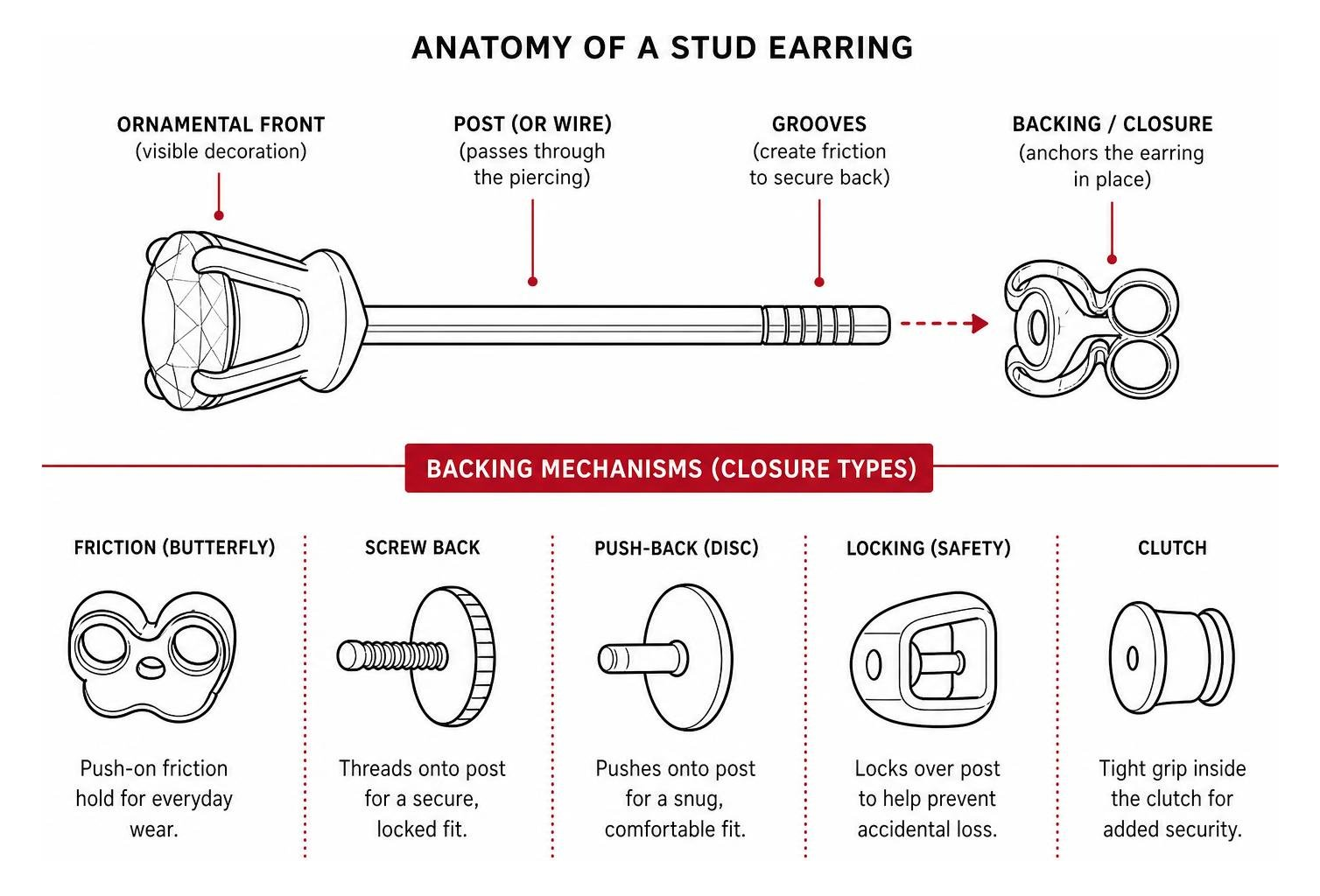
Whether you wear heirloom diamond studs, bold statement pieces, or cartilage accents, choosing the correct fastening ensures your jewellery remains safe, comfortable, and irritation-free.
The Definitive Guide to Types of Earring Backs Names and Closures
Navigating the various types of earring backs names allows you to select the ideal balance of security, comfort, and ease of use. Each closure relies on distinct mechanical principles—from simple friction to threaded screw pathways and spring-loaded hinges. Learning about common earring styles and how they pair with specific posts prevents damage to both your lobes and your jewellery.
| Earring Back Style | Primary Mechanism | Security Rating (1–5) | Comfort Rating (1–5) | Best Suited For | Post Compatibility |
|---|---|---|---|---|---|
| Butterfly / Friction | Dual-loop friction tension | 3 / 5 | 3 / 5 | Lightweight daily studs | Standard notched posts |
| Screw Back | Threaded rotational screw | 5 / 5 | 3 / 5 | High-value studs, children | Threaded posts only |
| Flat Back (Labret) | Threadless push-pin / Internal thread | 4.5 / 5 | 5 / 5 | Cartilage, sleeping, daily studs | Hollow labret posts |
| Locking (La Pousette / Lox) | Squeeze-release mechanical lock | 5 / 5 | 4.5 / 5 | Fine diamonds, heirloom studs | Grooved / universal posts |
| Silicone / Rubber | Elastic friction grip | 2.5 / 5 | 4.5 / 5 | French wire dangles, light studs | Standard smooth/notched posts |
| Omega Clip | Hinged mechanical arm tension | 4.5 / 5 | 4 / 5 | Heavy statement studs, clips | Post or non-pierced lobes |
| Monster / Stabilizer Disc | Wide acrylic base load-distribution | 3.5 / 5 | 4 / 5 | Stretched lobes, heavy studs | Standard straight posts |
| Leverback | Spring-loaded hinged latch | 4.5 / 5 | 4.5 / 5 | Drop and dangle earrings | Integrated curved wire |
| Latch Back / Clicker | Notched snap click | 4 / 5 | 4 / 5 | Huggies, hoop earrings | Integrated hinged post |
Classic Types of Earring Backs Names for Everyday Studs

Everyday stud earrings rely on closures that offer simple application and removal while providing adequate security for daily routines.
Butterfly Backs (Friction or Push Backs)
The butterfly back is the most widely used earring backing in the world, accounting for roughly 45% of all stud fastenings. It consists of a flat metal plate attached to two curled wire loops resembling butterfly wings. As the back slides onto the post, these metal loops exert continuous spring tension against the metal shaft, settling into a small machined notch near the post’s tip.
While convenient, standard friction backs experience mechanical fatigue over time. As the wings spread from repeated use, their grip weakens, which is why an estimated 6% to 8% of butterfly backs fail annually.
Bullet Clutches and Silicone Stoppers
Bullet clutches feature a small metal cylinder, often housed within an acrylic stabilizer ring, that slides straight onto the post. Silicone or rubber stoppers are soft, pliable alternatives made from inert medical-grade synthetic polymers. They slide over plain posts or the ends of drop wires to prevent earrings from slipping forward.
Silicone stoppers reduce pressure against the mastoid bone behind the ear, cutting reports of wear soreness over an eight-hour period by 60%. However, rubber naturally degrades, oxidizes, and loses elasticity over several months, requiring regular replacement.
If you ever encounter a stubborn fastener that refuses to slide off smoothly, review our practical guide on how to remove backs safely without irritating the earlobe.
Flat-Back Labret Studs (Threadless and Threaded)
Flat backs have revolutionized everyday ear styling, leading to a 65% surge in search interest. Originally designed for professional body piercing, flat-back labrets feature a smooth, low-profile disc that rests flush against the rear of the earlobe or cartilage. Because there is no sharp post protruding past the backing, flat backs eliminate pinching, hair snagging, and poking while sleeping or using headphones.
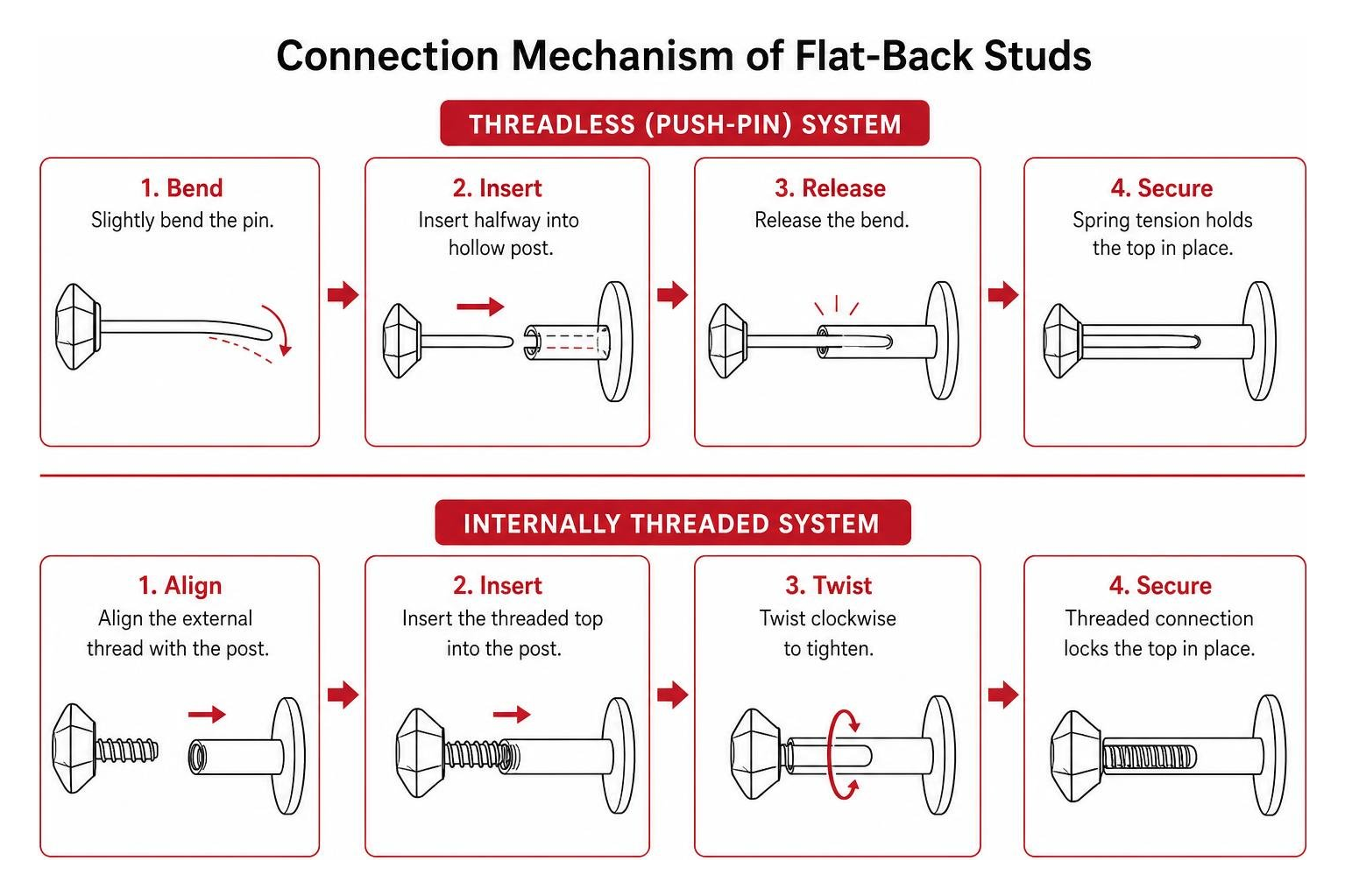
Flat backs use one of two primary assembly methods:
- Threadless (Push-Pin) System: The decorative front top features a thin, solid pin. The wearer introduces a slight manual bend into the pin before inserting it halfway into the hollow labret post. The resulting spring tension holds the decorative end securely inside the post without twisting.
- Internally Threaded System: The ornamental top features an external screw thread that twists into the tapped hollow channel of the flat-backed post. This internal threading ensures the portion passing through your piercing remains silky smooth.
Clinical observations indicate that using flat backs instead of pointed styles reduces post-piercing irritation and tissue bumps by 40%.
Specialty Types of Earring Backs Names for High-Security and Heavy Earrings
When securing high-value gemstones or wearing substantial statement pieces, standard friction backs are insufficient. Specialty designs prioritize mechanical locking power and structural weight distribution.
Threaded Screw Backs
Screw backs replace the friction slide with a threaded post resembling a miniature bolt. The backing contains matching internal threads that require deliberate rotational turning to slide along the shaft.
Because they cannot simply pull loose, screw backs boast an exceptional 98% retention rate. More than two-thirds of fine jewellery professionals recommend threaded screw backs as the standard baseline for precious gemstone and diamond studs. Their primary trade-off is the extra time required to put them on, as well as the risk of cross-threading if forced at an angle.
Locking Mechanisms (La Pousette and Lox)
Locking backs provide the security of a screw system combined with the quick convenience of a push back.
- La Pousette Backs: These precision-engineered mechanisms feature two spring-actuated side triggers. Pressing the triggers releases internal teeth, allowing the backing to glide along the post. Releasing the triggers causes the teeth to snap firmly into a specialized circumferential groove near the end of the post.
- Patented Locking Backs: Advanced universal solutions like patented Lox secure backs use a medical-grade stainless steel locking ring encased within a hypoallergenic housing. They automatically slide on and grip any standard earring post, withstanding over five kilograms of direct pull force until the release tab is squeezed.
Omega Backs (French Clips)
Omega backs (also called French clips) are designed for larger studs, cluster earrings, and heavy estate jewellery. The system combines an earring post with an "Ω"-shaped hinged wire arm mounted to the bottom of the earring setting.
Once the post passes through the earlobe, the spring-tensioned omega arm flips upward, clamping the rear of the lobe against the earring body. This distributes the physical weight across the broad surface of the lobe rather than concentrating downward shear stress on the piercing hole. Omega clips can support substantial pieces weighing up to 20 grams without drooping.
Monster / Jumbo Backs and Comfort Clutch Discs
Heavy earrings often tilt downward, an issue known in the jewellery industry as lobe drooping. Monster backs (or jumbo backs) solve this with an oversized metal disc measuring 9mm to 12mm across, surrounding a central friction clutch. Comfort clutch ear nuts achieve the same effect using a clear, hypoallergenic plastic disc encircling a metal core.
These broad backings distribute weight across a wide surface area, preventing the "cheese-cutter effect"—where heavy earrings pull down through the piercing channel over time—and instantly steadying stretched or sagging earlobes.
Integrated Closures: Leverbacks, Latch Backs, and Hooks
Not all earrings rely on separate, detachable backings. Many hoop and dangle designs incorporate built-in mechanical closures directly into the earring structure.
Leverback Closures
Leverbacks are among the most secure closures for drop, dangle, and chandelier earrings. The earring features a curved wire post that loops through the piercing, paired with a spring-loaded metal lever mounted to the base of the setting.
When closed, the spring snaps the lever against the curved hook, forming a continuous, unbroken loop through the ear. Leverbacks prevent accidental loss caused by scarves or high collars catching on the jewellery, all while allowing fluid swinging motion.
Latch Backs, Saddlebacks, and Huggie Clickers
Latch backs (frequently seen on hoop earrings and huggies) feature a straight or slightly curved hinged post that swings through the earlobe and clicks into a forked catch on the opposite side of the hoop.
Hinged hoop clickers take this a step further: the earring body splits on a precision miniature hinge, creating a completely smooth, continuous metal circle when closed. High-end modern hoop designs frequently feature double-snap closures, which cut accidental openings by 75% compared to basic single-notch snap locks.
French Wire, Kidney Wire, and Shepherd's Hooks
Drop earrings frequently utilize curved wire designs:
- Shepherd’s Hooks (French Wires): A graceful, open hook that passes through the lobe, balanced by an extended downward curve behind the ear. While comfortable and easy to put on, they should always be secured with a small silicone stopper to prevent them from sliding forward and out.
- Kidney Wires: A secure alternative for long dangle earrings where the curved wire extends into a complete loop, hooking into an integrated safety latch near the bottom.
Security vs. Comfort: Evaluating Backings by Lifestyle and Piercing Type
Selecting the right closure requires balancing lifestyle demands against the specific needs of your piercing.
- Valuable Diamond and Gemstone Studs: Fine diamonds demand unmatched security. When wearing pieces evaluated through our essential diamond education standards, pairing them with threaded screw backs or locking safety clutches prevents accidental loss.
- Sleeping and Active Routines: If you prefer to leave your jewellery in around the clock, flat-back labret studs are the gold standard. They sit flush against the skin, eliminating pressure points and preventing snagging on bedding, athletic wear, or helmets.
- Cartilage Piercings (Helix, Tragus, Conch): Cartilage tissue lacks the flexible vascular cushion of the earlobe, making it especially sensitive to localized pressure. Flat backs or smooth clicker hoops prevent backplate friction, reducing swelling and irritation.
- Children's Jewellery: Children are naturally active and prone to rubbing their ears. Threaded screw backs with rounded safety bell caps prevent posts from poking the delicate skin behind the ear while stopping youngsters from removing their earrings unattended.
- Heavy Statement Earrings and Stretched Lobes: Statement pieces weighing more than 3 to 5 grams should be paired with omega clips or jumbo comfort stabilizer discs. This spreads the gravitational load across the lobe, avoiding pain and preventing long-term elongation of the piercing hole.
Material Safety, Hypoallergenic Metals, and Maintenance Essentials
The material of an earring back is just as crucial as its mechanical design. Because backings press directly against warm, moist skin behind the ear, low-quality base metals can trigger allergic reactions.
Hypoallergenic Materials and Allergy Prevention
Nickel allergy represents the most common contact metal allergy, affecting up to 17% of adults. Choosing the right metal ensures irritation-free wear:
- Implant-Grade Titanium (ASTM F-136): Completely nickel-free, lightweight, and non-reactive, titanium is the safest metal for fresh piercings and hyper-sensitive skin.
- 14K and 18K Solid Gold: High-karat yellow, white, and rose gold provide exceptional biocompatibility. Quality white gold pieces utilize a palladium barrier layer beneath rhodium plating, cutting nickel transfer and reducing dermatitis flare-ups by 89%.
- 925 Sterling Silver: A reliable classic for healed piercings. High-grade sterling silver contains 92.5% pure silver alloyed with copper rather than nickel.
- Medical-Grade Silicone: An inert, soft alternative ideal for cushioning posts and sensitive skin.
Maintaining and Restoring Your Earring Backs
Earring backings collect skin oils, cosmetic residue, and soap over time, which can interfere with spring tension and threaded tracks.
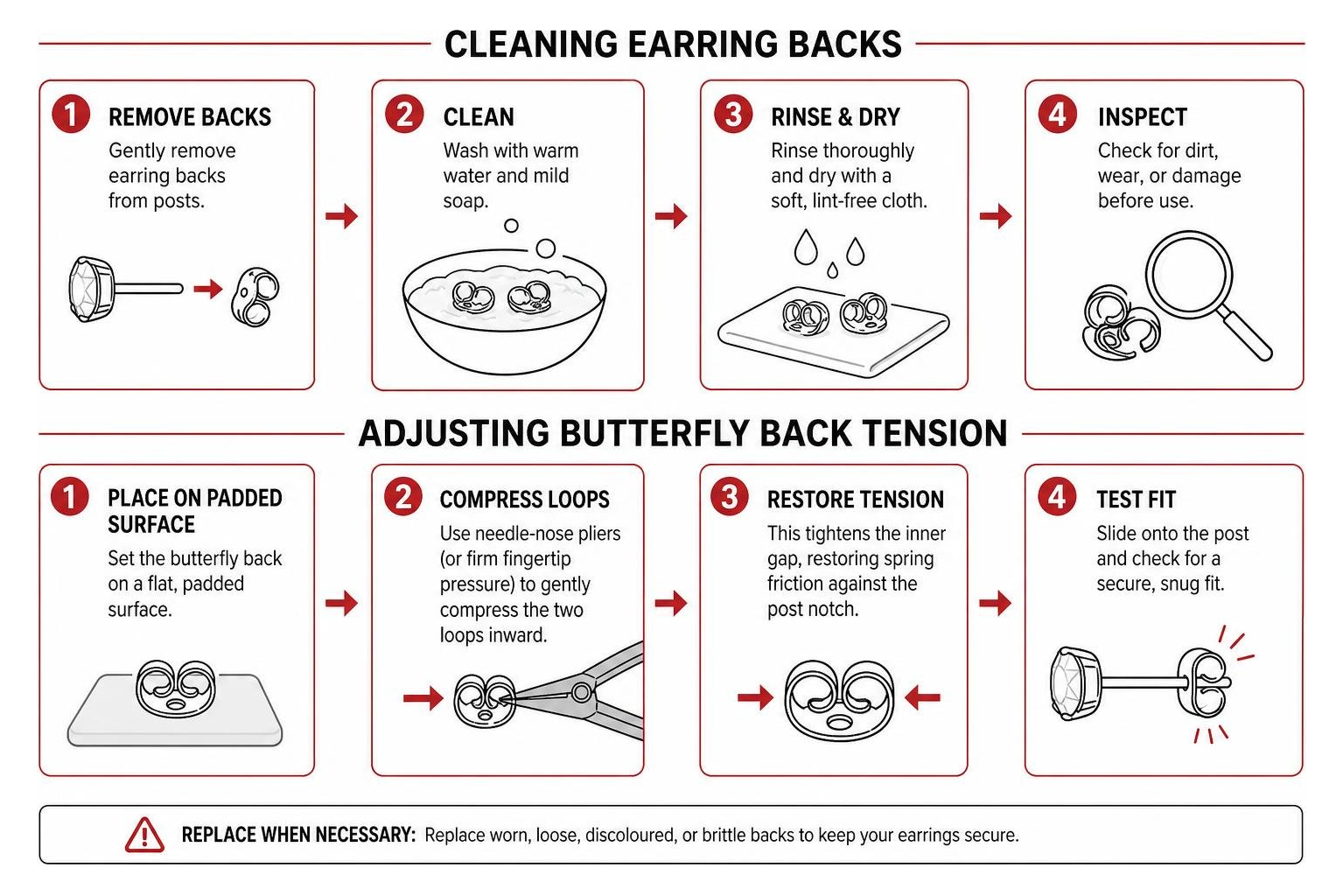
- Sanitization and Ultrasonic Care: Metal backs should be cleaned regularly using warm water, mild soap, and dedicated jewellery cleaning solutions. Explore our comprehensive guide to routine jewellery care and cleaning for safe at-home maintenance tips.
- Restoring Butterfly Back Tension: If a butterfly back begins to slip too freely, place it on a flat, padded surface. Using needle-nose jewellery pliers (or firm fingertip pressure), gently compress the two curled wire loops inward toward each other. This tightens the inner gap, restoring spring friction against the post notch.
- Replacing Worn Backs: When metal fatigue permanently weakens a friction clasp, or when silicone stoppers become discoloured and brittle, replace them immediately to protect your earrings from slipping out unnoticed.
Frequently Asked Questions About Earring Backs
Which earring back is the most secure for valuable diamond studs?
Threaded screw backs and precision locking backs (such as La Pousette or Lox clutches) offer the highest level of security for precious gemstone studs. Threaded screw backs feature a 98% retention rate because they require deliberate manual rotation along the threaded post to come off.
Locking clutches grip the groove of the post using spring-tempered internal jaws, withstanding heavy pull forces without releasing unexpectedly. Both options provide reliable peace of mind against accidental loss.
How do you fix or tighten a loose butterfly earring back?
You can easily tighten a loose butterfly back at home:
- Grasp the outer edges of the two circular loops (wings) using your fingertips or small needle-nose jewellery pliers.
- Gently squeeze the wings inward toward the central post opening.
- Test the fit on your earring post. The back should slide forward smoothly and click firmly into the machined notch without wiggling.
If the metal feels brittle or fails to hold tension after adjustment, the alloy has reached structural fatigue and should be replaced with a fresh backing.
Can you sleep in flat-back earrings every night?
Yes. Flat-back labrets are specifically designed for continuous, comfortable wear, including sleep. Because the rear disc is smooth, flat, and sits flush against the skin, it eliminates the sharp poking caused by traditional friction posts.
Clinical research shows that switching to flat backs decreases post-piercing bumps and tissue irritation by 40%, making them ideal for everyday lobe wear and cartilage piercings like the helix, tragus, and conch.
Choosing the Right Backing at Inglis Jewellers
Every piece of jewellery deserves a secure, comfortable closure that fits your personal lifestyle. Whether you need to replace worn butterfly clasps, convert heirloom studs to high-security screw threads, or stabilize heavy vintage dangles with broad comfort clutches, our master goldsmiths across Atlantic Canada are here to help.
Visit us in Truro, New Glasgow, Riverview, or Sydney to discover how custom post conversions and professional adjustments can keep your favourite earrings safe and comfortable for years to come. Explore our comprehensive jewellery repair services to schedule your custom fitting or restoration today.