


Yellow Gold Eternity Bands Are Back — Here's What You Need to Know
Yellow gold eternity bands are one of the most sought-after styles in bridal and fine jewelry right now — and for good reason.
If you want the short version before diving deeper:
Quick Guide: Yellow Gold Eternity Bands At a Glance
| What You Want to Know | The Answer |
|---|---|
| What is it? | A ring with diamonds set continuously around the entire band in yellow gold |
| Best gold karat options | 14k (more durable) or 18k (richer color) |
| Most popular diamond shapes | Round brilliant, emerald, oval, princess |
| Typical carat weights | 0.5ct to 6ct+ total weight |
| Price range | ~$499 to $78,000+ depending on diamonds and retailer |
| Best for | Wedding bands, anniversaries, stacking, right-hand rings |
| Natural vs. lab-grown | Lab-grown costs significantly less; same look and hardness |
After years of white gold and platinum dominating bridal jewelry, warm yellow gold is making a strong return. In June 2026, it's one of the most searched styles in engagement and wedding jewelry — and shoppers are choosing it for everything from minimalist stacking bands to bold statement pieces.
The appeal is real. Yellow gold flatters a wide range of skin tones, pairs beautifully with both vintage and modern diamond cuts, and carries a timeless warmth that cooler metals simply can't replicate.
Whether you're shopping for a wedding band, an anniversary gift, or a self-purchase, this guide covers everything you need to make a confident choice.
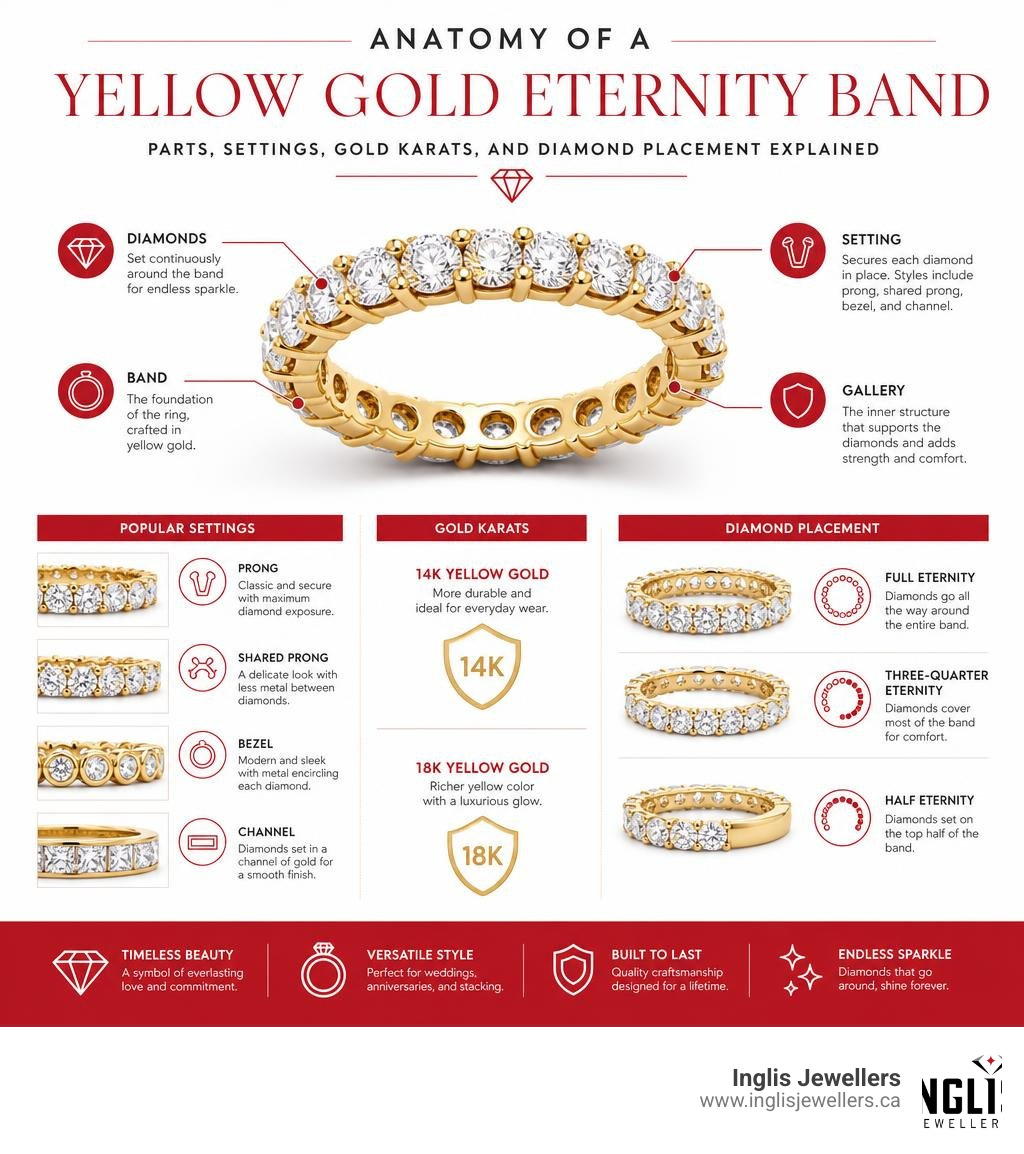
The Symbolism and Appeal of Yellow Gold Eternity Bands
There is something inherently poetic about an eternity band. Unlike a traditional ring with a clear "front" and "back," an eternity band features an uninterrupted line of diamonds or gemstones set around the entire circumference. Because a circle has no beginning and no end, this design has historically served as the ultimate symbol of eternal love, devotion, and a commitment that endures forever.
While they are highly popular as wedding bands, they are also the quintessential gift to mark major milestones, such as a milestone wedding anniversary or the birth of a child.
When you set these endless diamonds into yellow gold, the symbolism takes on an even warmer, richer meaning. Yellow gold has been prized by civilizations for millennia, representing purity, wealth, and warmth.
When choosing yellow gold eternity bands, one of the first decisions you will make is the gold purity:
- 14k Yellow Gold: Composed of 58.3% pure gold alloyed with other metals like copper and silver. It offers a beautiful, subtle yellow hue and outstanding durability. Because pure gold is soft, the alloys in 14k gold make it highly resistant to scratching and bending—ideal for active individuals or those who work with their hands.
- 18k Yellow Gold: Composed of 75% pure gold, this option boasts a noticeably richer, more vibrant golden-yellow hue. It feels heavier on the finger and offers a luxurious aesthetic. While slightly softer than 14k gold, it is still highly durable and offers excellent resistance to tarnish.
The warm undertones of yellow gold create a stunning contrast against white diamonds. While white metals blend in with the stones, yellow gold frames each diamond, making the icy brilliance of the gems pop with spectacular contrast.
Popular Diamond Cuts and Carat Weights for Yellow Gold Bands
The diamond cut you choose dictates the overall personality of your ring. Different shapes interact with light in unique ways, and when paired with yellow gold, the visual effect can range from a vintage glow to a crisp, modern sparkle.
Carat weight options also vary widely. You can find delicate bands starting around 0.50 carats total weight (ctw) all the way up to showstopping statement rings featuring 10 carats or more. Let's look at the most popular options.
Classic Round Brilliant Yellow Gold Eternity Bands
The round brilliant cut remains the undisputed king of sparkle. Engineered with 58 facets designed to maximize light return, round diamonds offer unmatched fire and brilliance.
When set in a shared prong setting - where adjacent diamonds share a metal basket - the amount of visible gold is minimized, allowing the diamonds to look like a floating river of light.
For those looking for an elegant, everyday option, a lower carat weight is highly versatile. For instance, a diamond shared prong eternity band in yellow gold featuring roughly 0.50ctw of natural diamonds offers a delicate 1.6mm profile. This slim design is incredibly comfortable and sits flush against most engagement rings.
If you prefer a bolder look with maximum presence, stepping up to a lab-grown diamond round eternity band in yellow gold with a 2.0ctw payload delivers a striking, high-impact sparkle that easily stands alone as a right-hand statement piece.
Modern Fancy Cuts: Emerald, Oval, and Cushion Shapes
If you want a ring that feels uniquely yours, fancy diamond cuts offer incredible character:
- Emerald Cut: This step-cut shape features long, parallel facets that create a "mirror-like" hall-of-mirrors effect. It is incredibly elegant and understated. An emerald-cut eternity band set in yellow gold yields a sophisticated, Art Deco-inspired aesthetic.
- Oval Cut: Combining the brilliant sparkle of a round diamond with an elongated shape, oval diamonds make the fingers look longer and slender. They have surged in popularity for their modern yet classic appeal.
- Cushion Cut: With rounded corners and larger facets, cushion-cut diamonds offer a romantic, vintage look that pairs beautifully with the warmth of yellow gold.
To explore the sheer variety of these configurations, browsing curated collections of diamond eternity bands highlights how fancy cuts - including radiant, marquise, and Asscher cuts - can be oriented vertically or horizontally (east-west) to create distinctive, customized silhouettes.
Comparing Yellow Gold to White Gold, Rose Gold, and Platinum

Choosing the right metal for your eternity band is about balancing daily wearability, skin tone compatibility, and personal style. Here is how yellow gold stacks up against the other major precious metals:
- White Gold: This alloy is mixed with white metals (like palladium or nickel) and plated with rhodium for a bright, reflective finish. While it offers a sleek, contemporary look, it requires periodic replating to maintain its white sheen. Yellow gold, by contrast, requires no plating and will never lose its warm color.
- Rose Gold: Created by alloying pure gold with copper, rose gold offers a romantic, vintage-inspired pink hue. While beautiful, it has a highly distinct color profile that may not pair as easily with other jewelry as classic yellow gold.
- Platinum: A naturally white, incredibly dense, and hypoallergenic metal. Platinum is highly durable, but it is also much heavier and more expensive than gold. Over time, platinum develops a soft, matte finish called a "patina." If you prefer a shiny, polished look without constant buffing, yellow gold is often the preferred choice.
| Metal Type | Color Profile | Durability | Maintenance Level | Hypoallergenic? |
|---|---|---|---|---|
| Yellow Gold (14k/18k) | Warm, rich, classic gold | High (especially 14k) | Low (occasional polishing) | Yes (unless allergic to nickel alloys in some 14k) |
| White Gold | Icy, bright white | High | Medium (needs rhodium replating) | No (often contains nickel) |
| Rose Gold | Soft, romantic pink | Very High (copper adds strength) | Low | No (contains copper) |
| Platinum | Cool, silvery-white | Extremely High (scratches but doesn't lose metal) | Medium (develops patina) | Yes (95% pure) |
Choosing the Perfect Yellow Gold Eternity Band for Stacking or Solo Wear
One of the best things about yellow gold eternity bands is their incredible styling versatility. They do not have to be worn exclusively as wedding rings; they can serve as right-hand rings, anniversary markers, or building blocks for a personalized ring stack.
- The Solo Statement: A thick eternity band (3mm to 5mm wide) featuring emerald or oval-cut diamonds has enough visual weight to be worn completely on its own. Worn on the ring or middle finger, it serves as a luxurious, self-contained statement.
- The Classic Wedding Stack: When pairing your eternity band with an engagement ring, pay attention to how the two bands sit next to each other. A low-profile, shared-prong round eternity band will sit flush against most classic solitaire settings.
- The Mixed-Metal Stack: Don't be afraid to mix your metals! Stacking a yellow gold eternity band between a white gold engagement ring and a rose gold plain band creates a chic, intentional, and highly textured look.
When you set out to shop wedding bands, consider how different textures - such as twisted bands, pavé settings, and high-polished plain metal bands - can be layered together to build a stack that tells your personal story.
Sizing and Width Tips for Your Yellow Gold Eternity Bands
Because an eternity band features diamonds wrapped around the entire finger, getting the correct size and width is absolutely paramount.
- The Width Factor: Slim bands (1.5mm to 2.2mm) are highly comfortable for daily wear and are perfect for stacking. Medium bands (2.5mm to 3.5mm) offer a balanced look that works well solo or paired. Wide bands (4.0mm and up) make a major statement but can feel tight on the finger, so you may need to size up slightly.
- The Comfort Fit: Look for bands with slightly rounded interior edges (known as a comfort fit). This makes the ring slide over the knuckle more easily and sit comfortably on the finger throughout the day as your hands naturally swell and shrink.
- The Precision Sizing Rule: Because resizing a full eternity band is incredibly difficult (and sometimes impossible), we highly recommend getting professionally sized at a local jeweler before making your purchase.
Frequently Asked Questions About Yellow Gold Eternity Rings
What is the difference between natural and lab-grown diamonds in yellow gold settings?
Both natural and lab-grown diamonds are physically, chemically, and optically identical. They both score a perfect 10 on the Mohs hardness scale and possess the exact same refractive index (sparkle). For a neutral gemological overview, the Gemological Institute of America explains the difference between natural and laboratory-grown diamonds in more detail.
The primary differences lie in their origin and price:
- Natural Diamonds: Formed deep within the Earth over billions of years under immense heat and pressure. They are rare, hold sentimental value for their natural origin, and carry a higher price tag. If you prefer a classic, natural stone, you can find stunning options featuring high-quality natural diamonds.
- Lab-Grown Diamonds: Grown in highly controlled laboratory environments that replicate the Earth's natural processes. Because the supply chain is shorter and more predictable, they cost significantly less - often saving buyers up to 60% or more compared to natural diamonds of equivalent quality. This makes larger carat weights highly accessible.
The choice comes down to personal preference, budget, and what matters most to you in a gemstone.
How do I clean and maintain a yellow gold eternity ring?
Because eternity bands have many small crevices around the prongs, they can easily trap dirt, lotion, and hand sanitizer, which dulls the diamonds' sparkle. Fortunately, keeping your ring clean at home is simple:
- The Soak: Fill a small bowl with warm water and add a few drops of mild dish soap (like Dawn). Let your ring soak for 15 to 20 minutes to loosen trapped debris.
- The Scrub: Use a clean, extra-soft bristle toothbrush to gently brush the diamonds. Be sure to clean underneath the stones where dirt accumulates.
- The Rinse & Dry: Rinse the ring thoroughly under warm running water (make sure the drain is plugged!). Pat dry with a lint-free microfiber cloth.
For long-term care, we recommend bringing your ring to a professional jeweler once a year. They can inspect the prongs under a microscope to ensure no diamonds have become loose and give the ring a professional ultrasonic cleaning.
Can a full eternity band be resized?
Generally speaking, no - a full eternity band cannot be easily resized. Because the diamonds go all the way around, there is no plain gold section at the bottom of the band to cut into. Attempting to stretch or compress the ring can warp the metal baskets, misalign the prongs, and cause the diamonds to fall out.
If you are concerned about your finger size changing over time, you have two excellent alternatives:
- The Half-Eternity Band: This style features diamonds across the top half of the band, while the bottom half is solid gold. This gives you the look of a full eternity ring from the top while allowing for easy resizing down the road.
- Sizing Beads: If your full eternity band is slightly too loose, a jeweler can solder small gold beads inside the inner band to help it fit snugly without altering the exterior diamond structure.
Conclusion
Yellow gold eternity bands represent the perfect intersection of timeless romance, modern style, and exceptional versatility. Whether you are celebrating a beautiful new marriage, marking a milestone anniversary, or simply treating yourself to a piece of jewelry that will last a lifetime, these warm, glowing bands are a magnificent choice.
If you are looking for wedding rings in Atlantic Canada or shopping for men's wedding rings in Atlantic Canada, we invite you to experience the Inglis Jewellers difference.
With convenient locations in Truro NS, New Glasgow NS, Riverview NB, and Sydney NS, our expert goldsmiths are ready to help you find or create the perfect ring. We specialize in bringing your unique vision to life with trusted craftsmanship and lifetime support.
Ready to design something truly spectacular? Visit our Goldsmith Studio to customize your dream ring and let us help you celebrate your love story with a piece that shines forever.