


What Makes Hand Engraved Wedding Bands Worth Knowing About
Hand engraved wedding bands are rings decorated with patterns, motifs, or messages carved by hand directly into the metal — using specialized tools called burins and gravers. No two are exactly alike.
Quick answers about hand engraved wedding bands:
- What they are: Rings with designs carved by hand into the metal surface, line by line
- Popular motifs: Scrolls, floral designs, laurel leaves, wheat sheaf, vines, and milgrain edging
- Best metals: 18ct yellow gold, platinum, and 14k rose gold
- Cost range: Varies widely — from a few hundred dollars for simple inner-band engraving to several thousand for fully custom work
- Production time: Typically 3 to 9 weeks depending on complexity
- Key advantage over laser engraving: Greater depth, unique variation, and a craftsmanship quality that machines cannot replicate
Human engraving on metal goes back further than most people expect. The earliest known engraving — a series of simple marks chiselled into shell — dates back roughly 540,000 years. By the time ancient Egyptians, Greeks, and Romans were crafting jewellery, engraving had become a refined art form tied to identity, status, and meaning.
That tradition carries forward into every hand engraved wedding band made today.
A hand engraved ring isn't just decorated. It's made — with skill, intention, and a level of personal expression that a plain or machine-made band simply can't match.
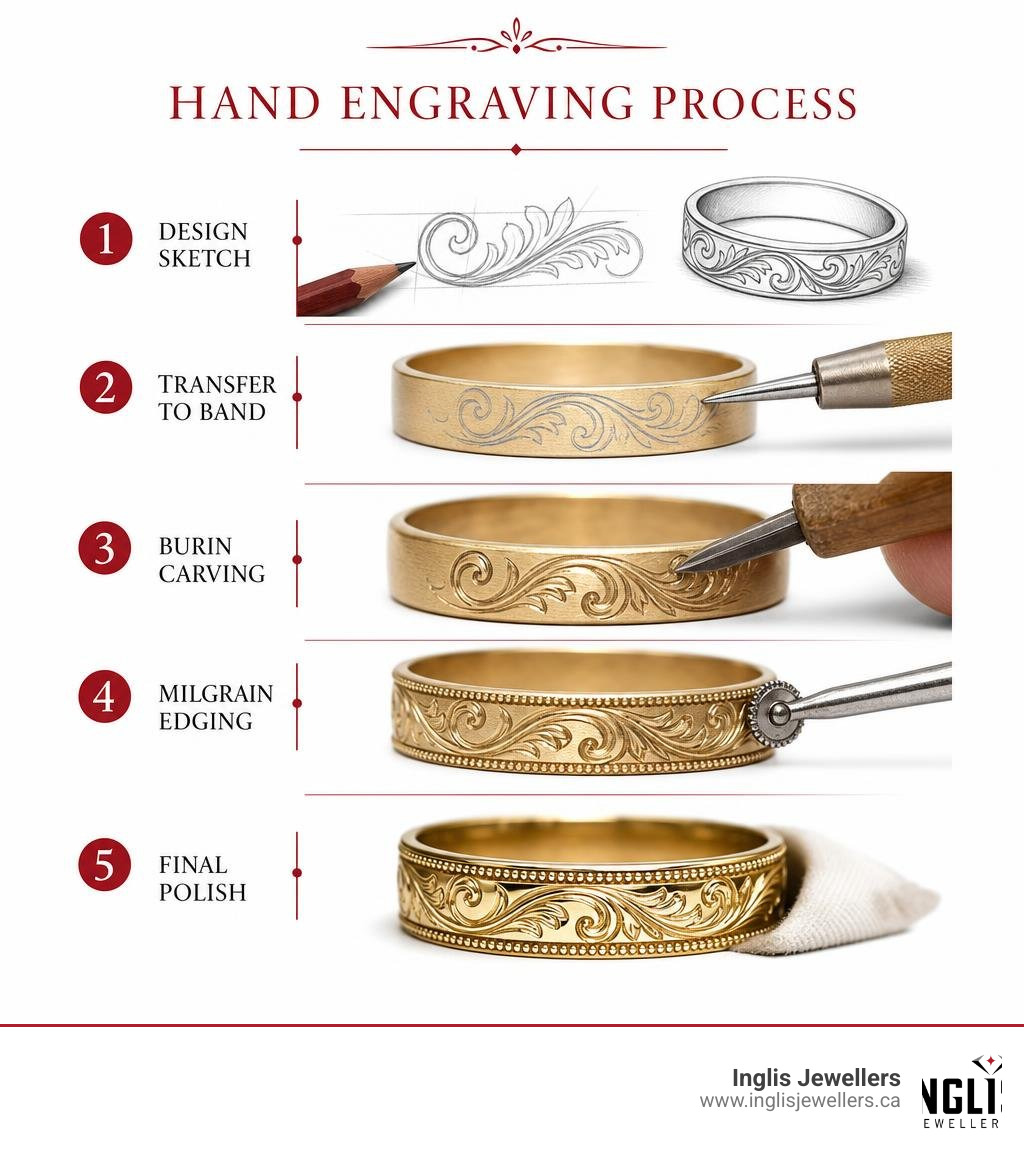
The Artistry and History of Hand Engraved Wedding Bands

To truly appreciate hand engraved wedding bands, we have to look back at how this ancient art form evolved. Long before modern machinery, the only way to decorate a piece of precious metal was with physical strength, a steady hand, and a sharp tool. The broader history of engraving shows just how deeply this craft is connected to art, identity, and ornamentation across cultures.
In ancient civilizations, engraved rings served as signets, carrying unique family crests used to stamp official wax seals. By the Middle Ages, the craft had evolved. Engravers began using the burin - a specialized chisel with a sharp, wedge-shaped tip - to cut intricate religious and heraldic motifs into noble jewelry.
During the Renaissance, the art of engraving reached new heights of complexity. Artisans took inspiration from classical mythology, carving incredibly detailed intaglios and cameos. By the 19th century, the Victorian era ushered in a deeply romantic period for jewelry design. Queen Victoria herself famously wore an orange blossom motif on her wedding crown, sparking a massive worldwide trend. In Victorian symbolism, the orange blossom represented optimism, purity, and prosperity in marriage, and it quickly became one of the most requested hand-engraved patterns for wedding rings.
As we moved into the 20th century, the organic, flowing lines of Art Nouveau gave way to the bold, geometric symmetry of Art Deco. Through every era, the tools remained remarkably consistent. Master goldsmiths relied on their trusted gravers - handheld steel tools with varying rounded, flat, or v-shaped ends - to shave away microscopic curls of gold or platinum.
This rich, artisanal heritage is what you carry when you wear a hand-engraved ring. It is an unbroken connection to centuries of human craft. For those looking to explore classic and contemporary collections of these wearable works of art, you can view a beautiful array of hand-engraved bands that celebrate this enduring legacy.
Popular Motifs for Hand Engraved Wedding Bands
When designing or selecting your band, the motif you choose defines its personality. Because the metal is carved line by line, a skilled engraver can adapt these patterns to virtually any band width. Here are the most popular traditional and modern motifs used today:
- Scroll Patterns: These flowing, wave-like patterns are a timeless favorite. Engravers often categorize them into Wriggle Scrolls (created by rocking the graver back and forth to create a textured, zig-zag line) and Cut Scrolls (clean, deep, sweeping cuts that mimic elegant calligraphy).
- Wheat Sheaf: Representing abundance, harvest, and a fruitful life together, the wheat sheaf pattern features repeating V-shaped cuts that mimic stalks of grain. It has a beautiful, structured texture that catches the light brilliantly.
- Laurel Leaves: A symbol of peace, victory, and eternity dating back to ancient Rome, laurel leaf patterns wrap around the band in an unbroken circle of leaves, offering a leafy, organic aesthetic.
- Milgrain Edging: Coming from the French word mille-grain, meaning "a thousand grains," milgrain is a decorative technique where tiny, precise beads of metal are applied to the borders of the ring. It frames the hand engraving beautifully, giving the band a finished, vintage-inspired look.
- Floral Designs: From delicate rose petals to winding vines, floral patterns bring an organic, soft elegance to a ring. Many couples choose specific flowers that hold personal meaning, such as the flower associated with the month they met.
For those who appreciate the crisp, clean look of white precious metals, exploring hand-engraved wedding bands in white gold is an excellent way to see how these traditional motifs stand out against a bright, modern backdrop. Alternatively, you can browse regional variations and classic designs to see how Canadian artisans bring these historical patterns to life.
Customizing Your Hand Engraved Wedding Bands
One of the greatest advantages of hand engraving over mass-produced jewelry is the unlimited potential for personalization. Because a real person is carving the ring, you are not restricted to a computer template.
Your Custom Vision:
- Inner-Band Messages: Dates, initials, secret jokes
- Custom Motifs: Hand-drawn flora, family crests, landscapes
- Gemstone Accents: Hidden birthstones, flush-set diamonds
- Personalized Coordinates: The exact spot you met or wed
Here is how you can make your hand-engraved band entirely your own:
- Inner-Band Messages: While the outside of the band showcases beautiful artwork, the inside can hold a private message. Many couples engrave significant wedding dates, coordinates of their first home, initials, or short, meaningful phrases.
- Custom Motifs: If you have a specific design in mind - such as a mountain range you love to hike together, a celestial map, or even a pattern matching a family heirloom - an artisan can draw a custom layout directly onto the metal before carving it.
- Gemstone Accents: You can easily combine hand engraving with gemstones. Adding flush-set diamonds within a floral scroll pattern or hiding a small, secret birthstone on the inside of the band adds an extra layer of color and sentiment.
- Textured Backgrounds: A master engraver can alter the background of the pattern using "stippling" (creating a dense pattern of tiny dots) or a matte finish. This creates a striking contrast, making the polished, engraved lines pop visually.
If you are looking for inspiration on how custom engraving can transform a simple band into a deeply personal story, check out the unique design variations available through custom hand-engraved bands.
Hand Engraving vs. Laser Engraving: Understanding the Difference

As technology has advanced, laser engraving has become incredibly common in the jewelry industry. While both methods place a design onto a ring, the process, appearance, and value of the finished pieces are night and day.
Laser engraving is a modern, automated process. A computer program guides a highly concentrated laser beam to burn or vaporize the very top layer of the metal. Because it is computer-driven, it can replicate incredibly complex logos, fonts, and photos with absolute precision. However, because the laser merely burns away a microscopic surface layer, the engraving is quite shallow and has a flat, dark, matte appearance. Over decades of daily wear, shallow laser engraving can gradually fade or wear smooth.
Hand engraving, on the other hand, is a purely physical, subtractive art form. The goldsmith uses a polished steel graver to physically slice and scoop out a sliver of precious metal. Because the tool is driven by human hands at an angle, it cuts a deep, V-shaped groove into the ring. This depth is key: the highly polished walls of the V-shaped cut act like tiny mirrors, catching and reflecting light in a way that laser engraving simply cannot duplicate.
Furthermore, hand engraving is incredibly durable. Because the cuts are deep, the design will easily last for generations, slowly wearing down into a soft, beautiful patina without losing its essential detail. Each hand-engraved ring also carries tiny, charming variations. No two cuts are mathematically identical, giving your ring a distinct, soulful character.
| Feature | Hand Engraving | Laser Engraving |
|---|---|---|
| Tool Used | Steel gravers and burins (manual) | High-powered laser beam (computer-guided) |
| Depth of Cut | Deep, physical V-shaped grooves | Very shallow, surface-level vaporization |
| Light Reflection | High; polished cuts catch and refract light | Low; flat, matte, or burnt appearance |
| Longevity | Heirloom quality; lasts generations | May wear smooth over decades of heavy use |
| Uniqueness | One-of-a-kind; minor artisan variations | Perfectly identical; mass-reproducible |
| Artisanal Value | High; preserves historic heritage craft | Lower; automated machine process |
Choosing the Right Metals and Caring for Your Ring
Not all metals behave the same way under an engraver's tool. Choosing the right metal is crucial to ensuring your hand-engraved pattern looks crisp on day one and remains beautiful in 2050 and beyond.
- 18k Yellow Gold: Widely considered the gold standard for hand engraving. Containing 75% pure gold, 18k gold is highly malleable yet durable enough for daily wear. It cuts like butter under a master's graver, allowing for incredibly clean, fluid lines and exceptionally bright, reflective cuts.
- 14k Rose Gold: Rose gold gets its romantic pink hue from copper. This copper alloy makes 14k rose gold significantly harder than yellow gold. While it requires more physical effort and sharp tools to engrave, the warm blush tone provides a stunning, high-contrast backdrop that highlights vintage-style scrollwork beautifully.
- Platinum: For a silver-coloured band, platinum is the ultimate choice. It is dense, heavy, and hypoallergenic. Unlike gold, which is shaved away during engraving, platinum is "gummy" and tends to displace rather than shed metal. Engraving platinum requires immense skill and patience, but because platinum does not wear away over time, an engraved pattern on a platinum band is virtually indestructible.
- What to Avoid: We generally advise against choosing sterling silver for an everyday wedding band. Silver is a soft metal that scratches easily, meaning intricate engraving will lose its crispness within a few years of daily wear.
Caring for Your Hand Engraved Wedding Band
Because hand-engraved rings feature microscopic crevices and deep cuts, they can trap everyday dirt, lotion, and soap residue, which can dull their natural sparkle. Fortunately, keeping your ring clean at home is simple.
- The Warm Soak: Fill a small bowl with warm water and add a few drops of mild dishwashing liquid. Soak your ring for 10 to 15 minutes to soften any trapped dirt or oils.
- The Gentle Brush: Take an extra-soft toothbrush (a baby toothbrush works perfectly) and gently brush the engraved areas. Avoid using stiff bristles, as they can cause micro-scratches on highly polished surfaces.
- Rinse and Dry: Rinse the ring thoroughly under warm running water (make sure the sink drain is closed!). Dry it with a soft, lint-free microfiber cloth.
- When to Remove It: To preserve the fine details of your engraving, always remove your ring during heavy manual labor, gym sessions, gardening, cleaning with harsh chemicals, or swimming in chlorinated pools.
Frequently Asked Questions about Hand-Engraved Rings
How long does it take to create a custom hand-engraved band?
Because hand engraving is a meticulous, step-by-step process, it requires patience. A typical made-to-order hand-engraved ring takes anywhere from 3 to 9 weeks to complete. This timeline includes the initial design consultation, creating a hand-drawn layout on the metal band, sending a photo or video preview for your approval, the physical carving process, and final polishing. We always recommend starting the process at least 6 to 8 weeks before your wedding day to ensure ample time for a perfect finish.
Can hand-engraved wedding bands be resized?
Resizing a fully hand-engraved "eternity" band (where the pattern wraps all the way around the ring) is highly challenging. Cutting into the band to add or remove metal will inevitably disrupt the continuity of the pattern, leaving a visible seam.
To plan around this, we recommend choosing a "court profile" or a band designed with a small, smooth "sizing bar" at the very bottom. This solid, unengraved section of metal allows a goldsmith to easily resize the ring in the future without touching the beautiful artwork on top.
What factors influence the cost of hand engraving?
The price of a hand-engraved ring is determined by three main factors:
- Metal Choice: Platinum and 18k gold are more expensive raw materials and require more specialized labor to engrave than 14k gold.
- Pattern Complexity: A simple inner-band initials engraving is highly affordable, whereas a fully wrapped, intricate floral scroll pattern with milgrain borders requires hours of highly focused manual labor by a master artisan.
- Band Width: Wider bands (such as 5mm to 7mm rings) provide a larger canvas, requiring more detailed carving and time than a delicate 2mm band.
Conclusion
A wedding band is the one piece of jewelry you will wear every single day for the rest of your life. While plain bands are classic, choosing a hand-engraved band elevates your ring from a simple symbol of commitment into a breathtaking piece of personal history.
At Inglis Jewellers, we believe in the power of trusted craftsmanship. As a premier Canadian jewelry retailer with full-service support across Atlantic Canada—including our local showrooms in Truro, NS, New Glasgow, NS, Sydney, NS, and Riverview, NB—we are dedicated to helping you create or find a piece that speaks to your unique love story.
Whether you want to select a classic vintage motif or collaborate on a completely custom design, our team is here to guide you every step of the way. To learn more about our in-house custom creation capabilities, visit our dedicated Goldsmith Studio and let’s begin crafting an heirloom that you will be proud to pass down for generations.