


What Are Diamond Bezel Set Earrings and Why Are They So Popular?
A bezel setting—often historically referred to as a rubbed-over setting—is one of the oldest jewellery-setting techniques in existence, yet it delivers one of the most distinctly modern aesthetics. Instead of holding a gem aloft with individual wire claws or prongs, a bezel setting encircles the entire perimeter of the diamond with a custom-fitted collar of precious metal. The goldsmith carefully burnishes this metal rim over the diamond’s girdle, locking it securely in place flush against the mounting.
This construction makes the design exceptionally practical. Because the metal collar wraps entirely around the diamond's edges, there are no exposed sharp facets or delicate prongs sticking outward. If you wear sweaters, scarves, knit blankets, or face masks, you know the frustration of traditional earring prongs snagging loose threads. A bezel setting eliminates this issue entirely, creating a smooth, snag-free exterior.
Furthermore, bezel settings sit very low against the earlobe. Traditional prong mountings raise the diamond high above the base to let light enter from the sides, but this height makes studs stick out, tilt forward, or feel unbalanced. A bezel stud offers a sleek, low-profile silhouette that hugs the ear cleanly.
This functional design has made bezel-set studs an essential staple among modern fine fashion earrings. They provide an effortless way to wear genuine diamonds daily without constantly worrying about losing a stone or scratching delicate fabrics.
Bezel vs. Prong Settings: Key Benefits
Choosing between bezel and prong mountings comes down to balancing protection, profile, and aesthetics.
| Feature | Bezel Setting | Prong Setting |
|---|---|---|
| Stone Security | Complete 360° perimeter metal collar prevents loosening and protects fragile diamond girdles from chipping. | 3 to 6 individual metal claws hold the stone; individual prongs can bend, snag, or wear down over time. |
| Profile on Ear | Low-profile and flush; sits flat against the earlobe without tilting forward. | Elevated profile; extends outward from the ear, which can feel top-heavy on smaller lobes. |
| Everyday Durability | Exceptional; ideal for active lifestyles, workouts, sleeping, and layering. | Moderate; requires regular prong re-tipping and periodic checks to prevent stone loss. |
| Fabric Snagging | Zero snagging; smooth polished metal edges glide effortlessly over clothes and hair. | Prongs easily catch on knit sweaters, winter scarves, lace, and loose hair strands. |
| Cleaning & Upkeep | Easy to wipe clean; no small gaps between delicate prongs to collect lint. | Dirt, hair, and lotion frequently build up under and around the prongs, requiring detailed cleaning. |
For active individuals who want fine jewellery they can leave in through workouts, busy workdays, and weekend travel, the protective nature of a bezel mount offers peace of mind that prong settings simply cannot match.
Visual Impact and Size-Enhancing Effect
Beyond structural durability, bezel mountings provide a visual benefit: they make diamonds appear noticeably larger on the ear.
When a goldsmith seats a round brilliant diamond into a bezel, the metal surrounding the stone is mirror-polished. The bright reflection of this surrounding metal collar blends seamlessly into the brilliant facets of the diamond. Viewed from the front, the eye perceives the combined diameter of the diamond and the metal rim as a single, unified sparkling surface.
This optical illusion enhances the presence of smaller or medium-sized stones. For example, a 0.50-carat round diamond set in a polished white metal bezel often presents the visual diameter of a 0.70-carat or larger prong-set stone. The result is a bold, flush, contemporary look that commands attention while maintaining a refined profile. According to the Gemological Institute of America, bezel settings are among the most secure mounting styles available for everyday fine jewellery.
Diamond Selection: The 4Cs, Natural vs. Lab-Grown, and Sizing
Selecting diamonds for bezel studs requires understanding how diamond characteristics interact with a solid metal frame. While the universal standard of diamond grading—Cut, Colour, Clarity, and Carat Weight—remains essential, the bezel setting introduces unique grading nuances across all diamond jewelry.
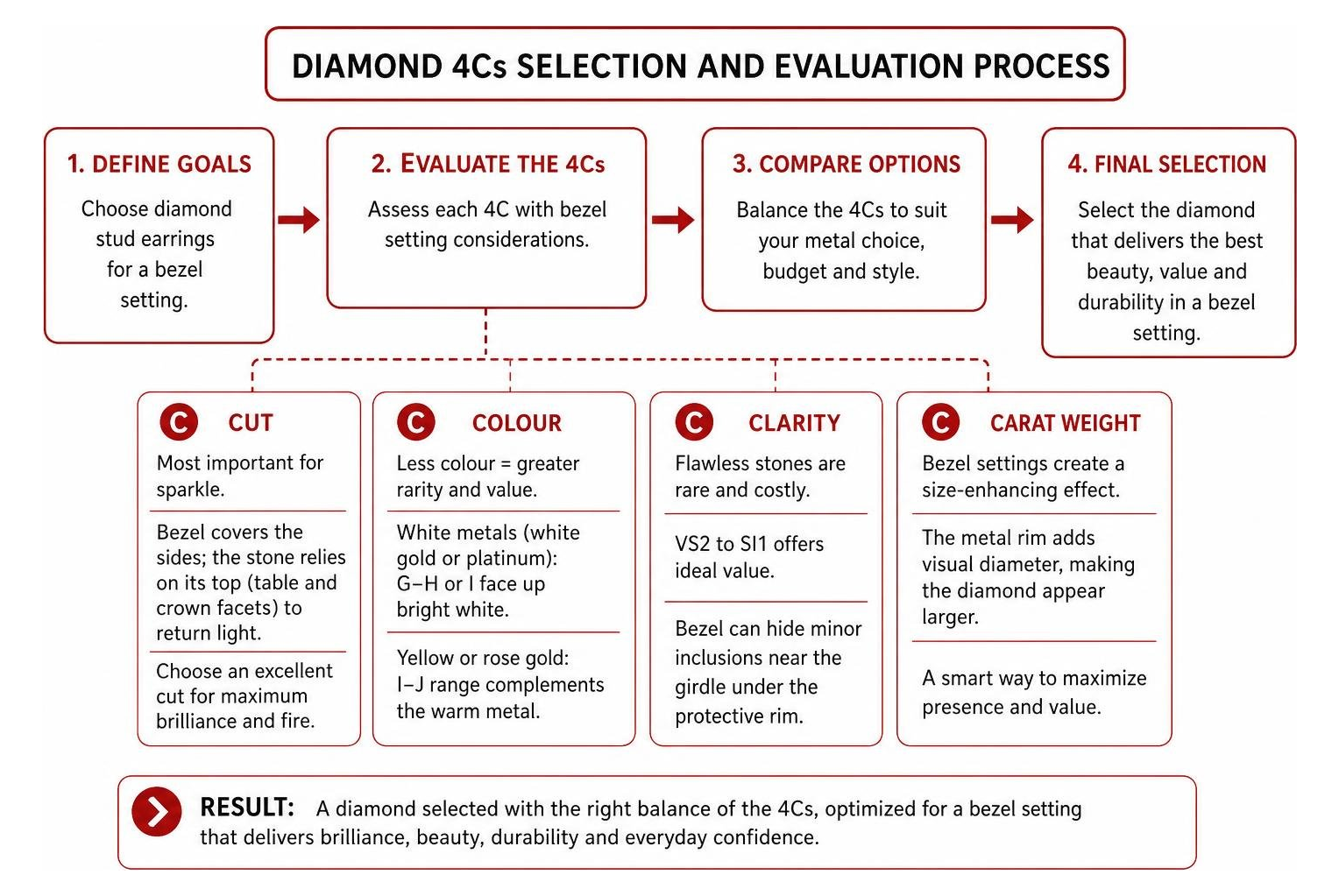
The 4Cs in Bezel Settings
- Cut: Cut quality is the single most important factor for sparkle. Because a bezel covers the diamond's sides (the pavilion and girdle), the stone relies entirely on its top table and crown facets to draw in light, refract it, and disperse it back to your eyes. An excellent cut ensures maximum brilliance and fire, preventing the diamond from appearing dark inside the metal cup.
- Colour: The Gemological Institute of America (GIA) grades diamond colour on a scale from D (colourless) to Z (light yellow or brown). As a rule, less colour indicates greater rarity and higher value. However, bezel settings allow flexibility. If you choose white gold or platinum, stones in the near-colourless range (G to H or I) face up bright white because the cool metal reflects through the stone. If you select yellow or rose gold, the warm metal naturally complements diamonds in the I to J range, allowing you to maximize carat weight without paying for colourless grades you cannot detect once mounted.
- Clarity: Flawless diamonds containing no natural inclusions under 10x magnification are exceptionally rare and carry substantial price premiums. Most commercially sold fine diamonds contain natural inclusions (internal characteristics) or blemishes (external marks) that are completely undetectable to the naked eye. In a bezel setting, stones graded VS2 to SI1 offer ideal value. Furthermore, a bezel can hide minor natural inclusions situated along the outer edge (girdle) of a diamond beneath the protective rim.
- Carat Weight: Diamond weight is measured in metric carats. For earrings, sizing is almost always expressed as the combined weight of both stones.
Natural Diamonds vs. Lab-Created Diamonds
When commissioning or purchasing studs, you have two distinct paths for diamond origin: natural mined diamonds or lab-created diamonds.
Lab-created diamonds are chemically, physically, and optically identical to natural earth-mined diamonds. They share the exact same crystal carbon lattice, hardness rating (10 on the Mohs scale), refractive index, and fire. The only difference is their origin. While natural diamonds formed billions of years ago under intense heat and pressure deep within the Earth's mantle, lab-grown stones are cultivated in high-tech laboratories replicating those exact geological conditions using High Pressure-High Temperature (HPHT) or Chemical Vapour Deposition (CVD) methods.
| Factor | Natural Earth-Mined Diamonds | Lab-Created Diamonds |
|---|---|---|
| Chemical Composition | 100% Pure Crystallized Carbon | 100% Pure Crystallized Carbon |
| Hardness (Mohs Scale) | 10 (Most durable gemstone known) | 10 (Most durable gemstone known) |
| Brilliance & Fire | Identical optical properties | Identical optical properties |
| Origin & Rarity | Mined from natural geological deposits; finite earth supply. | Grown in specialized facilities replicating earth's natural mantle conditions. |
| Pricing & Value | Higher cost reflecting rarity, mining, and long-term geological value retention. | Lower entry price (often 30% to 60% less), allowing for larger total carat weights within budget. |
Whether you choose mined stones certified as conflict-free or opt for lab-grown options, both will maintain their brilliance and structural integrity permanently in a bezel mounting.
Sizing and Total Carat Weight for Diamond Bezel Set Earrings
When shopping for diamond earrings, always confirm whether the listed carat weight refers to each individual earring or the Total Carat Weight (TCW or CTW) of the pair.
In almost all retail settings, the stated weight represents the combined weight of both studs. For example, a pair listed as 1.00ctw contains two 0.50ct diamonds (one for each ear).
Matching two stones for earrings requires meticulous gemological care. Because the human eye compares them side-by-side on either side of the face, the two stones must share identical millimeter dimensions, table percentages, colour grades, and visual spreads.
For those seeking distinctive geometry beyond classic round cuts, modern designs incorporate fancy shapes. Our 14k Yellow Gold .44ctw Mixed Shape Diamond Bezel Studs illustrate how pairing unique silhouettes like pears, emerald cuts, or ovals within protective gold bezels creates an artistic, contemporary look.
Typical millimeter diameter sizing for round bezel-set diamonds:
- 0.25 ctw (approx. 0.12ct per ear): ~3.2mm diamond + ~1mm bezel = ~4.2mm total visible diameter
- 0.50 ctw (approx. 0.25ct per ear): ~4.1mm diamond + ~1mm bezel = ~5.1mm total visible diameter
- 1.00 ctw (approx. 0.50ct per ear): ~5.1mm diamond + ~1.2mm bezel = ~6.3mm total visible diameter
- 1.50 ctw (approx. 0.75ct per ear): ~5.8mm diamond + ~1.2mm bezel = ~7.0mm total visible diameter
- 2.00 ctw (approx. 1.00ct per ear): ~6.5mm diamond + ~1.4mm bezel = ~7.9mm total visible diameter
Metal Choices, Earring Backs, and Durability
The precious metal chosen for a bezel mounting serves both structural and aesthetic functions. Because the metal directly wraps the stone, its tone influences the diamond's perceived colour, and its purity determines long-term wear characteristics.
Precious Metal Options
- 14k & 18k White Gold: White gold offers a sleek, modern, silvery finish that enhances diamond brightness. Standard white gold is alloyed with durable metals and plated with rhodium for a mirror-like finish. It provides strong structural strength to maintain a crisp bezel rim.
- 14k & 18k Yellow Gold: Yellow gold provides a warm, classic contrast against colourless stones. It highlights the distinct circular or geometric outline of the bezel, making the craftsmanship stand out.
- 14k & 18k Rose Gold: Rose gold adds a romantic, vintage-inspired hue. Its copper content makes it slightly more durable than yellow gold, and it pairs beautifully with warm or neutral skin tones.
- 950 Platinum: Platinum is naturally hypoallergenic, exceptionally dense, and maintains its bright white sheen without requiring rhodium replating. Because platinum is a ductile metal, it does not wear away over decades; rather, the metal displaces, creating a soft patina that protects the diamond securely.
- 10k Gold: For petite studs or everyday budget-conscious pieces, 10k gold offers exceptional hardness and scratch resistance. Designs like our 10k White Gold .08ctw Diamond Bezel Studs deliver daily durability and understated sparkle at an accessible price point.
Earring Backs for Maximum Security
A secure setting deserves an equally dependable closure. Because bezel studs are built for continuous, active wear, selecting the right backing ensures your investment stays firmly in place.

- Friction / Push Backs (Butterfly Backs): The most common earring back. They slide onto a notched post and stay in place through mechanical tension. While comfortable and easy to put on, standard friction backs can loosen over years of use and require periodic tightening.
- Screw Backs: The post is threaded like a screw, requiring the backing to be wound onto the stem until it sits flush behind the earlobe. Screw backs offer exceptional protection against accidental loss, making them popular for valuable diamond studs, though they require a bit more time to put on and remove.
- Locking / Protektor Backs (e.g., Lox Backs): Advanced locking systems use internal stainless steel or synthetic gripping mechanisms that automatically squeeze and lock onto a grooved post. They can only be released by squeezing two release tabs simultaneously, combining the convenience of push backs with the security of screw backs.
Cost Factors, Custom Ordering, and Long-Term Care

The price of bezel-set diamond studs depends on four main variables: diamond origin (natural vs. lab-grown), total carat weight, diamond quality (cut, colour, clarity), and metal purity.
Exploring our full range of diamond stud earrings shows options tailored to every budget:
- Entry-Level Everyday Studs (0.05ctw to 0.25ctw): Typically range from $150 to $600 CAD depending on metal choice (10k or 14k gold).
-
Mid-Range Everyday Luxury (0.30ctw to 0.75ctw):
- Lab-Grown: $500 to $1,200 CAD
- Natural Mined: $900 to $2,500 CAD
-
Solitaire Statement Studs (1.00ctw to 2.00ctw+):
- Lab-Grown: $1,200 to $3,500 CAD
- Natural Mined: $3,500 to $12,000+ CAD
For instance, a classic 1.00ctw pair in 18kt white gold featuring high-grade natural diamonds (such as G-H colour and VS2-SI1 clarity) represents a lasting fine jewellery benchmark, combining substantial finger-to-lobe presence with long-term investment value.
Customizing Your Diamond Bezel Set Earrings and Production Timelines
Custom jewellery allows you to dictate every detail—from selecting ethically sourced gemstones to adjusting the thickness and profile of the metal collar.
Many clients utilize semi-mount services, where a custom bezel setting is fabricated to house diamonds passed down through family heirlooms or unset stones sourced specifically for the project.
The bespoke process follows clear milestones:
- Design & Gemstone Selection: Choosing natural or lab-grown diamonds, assessing matched pairs, and selecting precious metal (Platinum, 14k/18k Yellow, White, or Rose Gold).
- CAD Modelling & Goldsmithing: Digital 3D modeling followed by hand-carving or precision casting.
- Stone Setting & Mirror-Polishing: The goldsmith seats each diamond and burnishes the bezel over the girdle before applying a high-polish or matte finish.
- Lead Time: Typical custom production takes 2 to 4 weeks from final design approval to delivery.
Cleaning, Maintenance, and Warranty Coverage
While bezel settings are among the lowest-maintenance jewellery designs available, basic routine care keeps the stones brilliant.
- At-Home Cleaning: Soak earrings in warm water mixed with a few drops of mild, degreasing dish soap for 10 to 15 minutes. Use an extra-soft baby toothbrush to gently clean behind the setting and across the top table of the stone. Rinse thoroughly with warm water and pat dry with a lint-free microfiber cloth.
- Ultrasonic Cleaners: Because diamonds and solid gold/platinum are durable, bezel studs can safely be cleaned in at-home or professional ultrasonic baths (provided the diamond has not undergone fracture-filling treatments).
- Professional Inspections: We recommend bringing fine jewellery in once a year. A goldsmith can inspect the bezel rim under magnification to ensure no heavy impacts have shifted the metal, check post alignment, and professionally polish the metal.
Reputable jewellers support their craftsmanship with comprehensive warranties covering manufacturing integrity, alongside clear exchange and return policies.
Frequently Asked Questions About Bezel Set Diamond Earrings
Are bezel settings secure enough for daily wear and active lifestyles?
Yes. The bezel setting is the most secure mounting style in fine jewellery. By enclosing the entire perimeter (girdle) of the diamond in a solid rim of precious metal, it eliminates prongs that can snag, bend, or pull open during sports, sleep, or daily routines.
Do bezel settings make diamonds look smaller or larger on the ear?
Bezel settings almost always make diamonds look larger on the ear. When crafted from polished white gold, yellow gold, or platinum, the mirror-polished metal rim reflects light alongside the diamond’s facets. The human eye views the combined diameter of the stone and the metal border as one single sparkling unit.
Can bezel earrings be customized with fancy diamond shapes or alternative gemstones?
Yes. Bezels can be custom-fabricated for any geometric shape, including emerald, oval, pear, cushion, and marquise cuts. Furthermore, bezels work exceptionally well with coloured gemstones like sapphires, rubies, and emeralds, providing protective borders for softer stones while framing their vibrant colours.
Conclusion
Diamond bezel set earrings combine durable craftsmanship with modern styling. By replacing delicate prongs with a smooth, protective rim of precious metal, they deliver a snag-free, low-profile design built for daily wear without compromising brilliance. Whether you prefer the heritage of natural diamonds or the accessible scale of lab-grown stones, bezel studs remain an enduring wardrobe essential.
If you are ready to design a custom pair or find the perfect everyday studs, explore the custom design services at Inglis Jewellers or visit our master goldsmiths across Atlantic Canada in Truro, New Glasgow, Sydney, and Riverview.