


What Does a 3 Carat Diamond Ring Actually Cost in 2026?
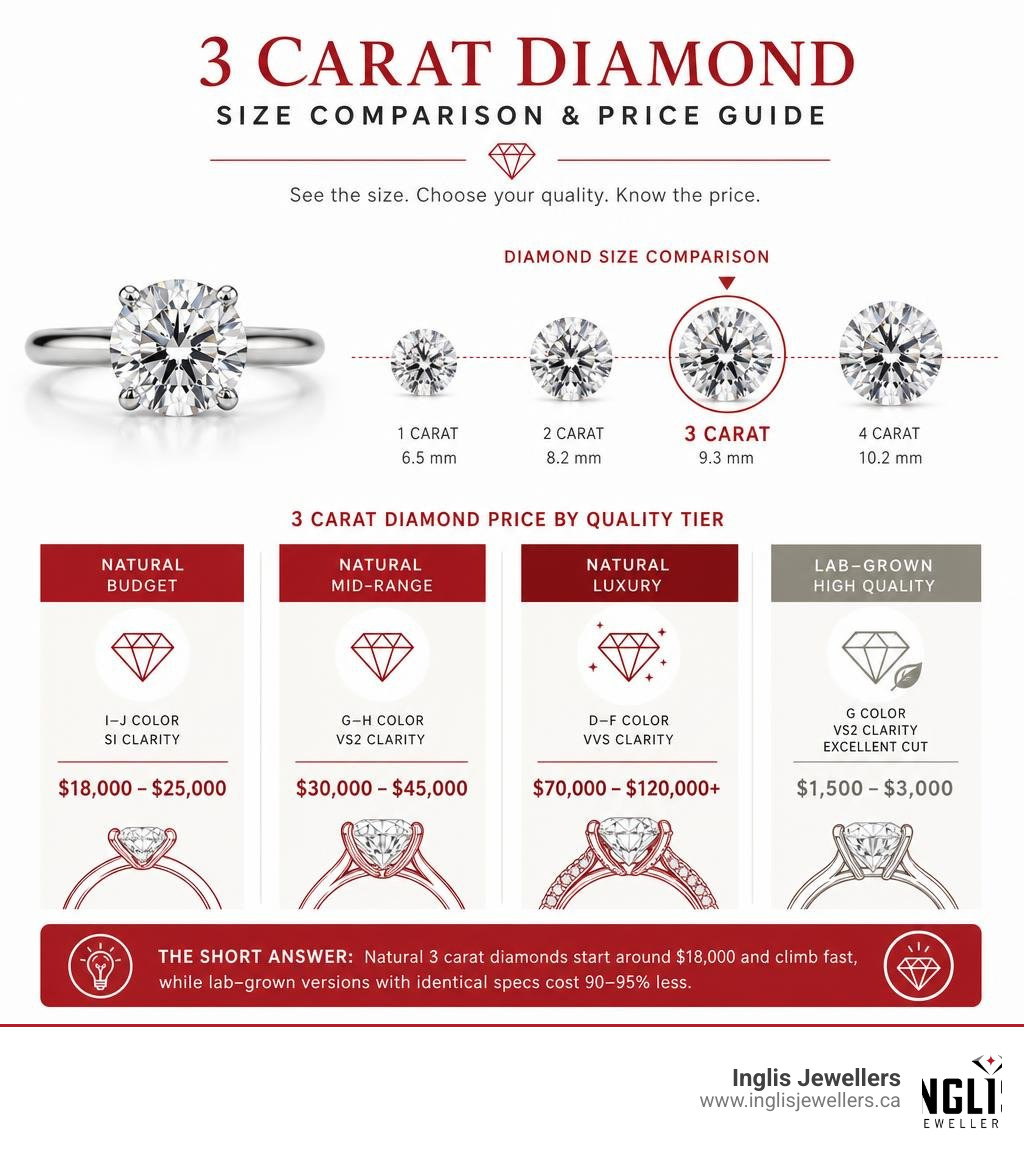
The 3 carat diamond ring price in 2026 spans a surprisingly wide range — here's a quick breakdown before we dive into the details:
| Diamond Type | Quality | Price Range (USD) |
|---|---|---|
| Natural | Budget (I-J color, SI clarity) | $18,000 – $25,000 |
| Natural | Mid-range (G-H color, VS2 clarity) | $30,000 – $45,000 |
| Natural | Luxury (D-F color, VVS clarity) | $70,000 – $120,000+ |
| Lab-grown | High quality (G color, VS2, Excellent cut) | $1,500 – $3,000 |
The short answer: natural 3 carat diamonds start around $18,000 and climb fast, while lab-grown versions with identical specs cost 90–95% less.
You've probably looked at a 3 carat ring at some point and thought, "someday." But here's the thing — the gap between a dream and a purchase gets a lot smaller once you understand exactly what drives the price tag.
A 3 carat diamond isn't just bigger than a 1 carat stone. It's exponentially rarer. The rough crystals needed to cut a clean 3 carat polished diamond are statistically uncommon, and that scarcity pushes natural diamond prices up steeply. At the same time, lab-grown technology has made the same visual impact accessible at a fraction of the cost.
This guide breaks down everything — what you'll pay, why, and how to make the smartest decision for your budget and lifestyle.
Understanding the 3 Carat Diamond Ring Price in 2026
When we talk about a 3 carat diamond ring, we are crossing the threshold from standard bridal jewelry into true statement-piece territory. In 2026, the retail market is more diverse than ever, offering distinct paths depending on whether you value the geological rarity of a mined stone or the high-tech value of a lab-grown alternative.
The most critical concept for any buyer to grasp is exponential scaling. If a high-quality 1 carat natural diamond costs $5,000, you might logically assume a 3 carat diamond would cost $15,000. Unfortunately, the diamond market doesn't play by linear rules. Because large, gem-quality rough diamonds are incredibly rare to find in the earth, a 3 carat natural diamond can easily cost ten times more than a 1 carat stone of equivalent quality. You are paying a massive premium for sheer physical rarity.
Conversely, lab-grown diamonds do not suffer from the same geological limitations. While growing a larger diamond crystal requires more time and highly calibrated machinery, the supply chain is highly efficient. This fundamental difference has created a massive pricing divergence that shapes every buying decision today.
Determining the Natural 3 Carat Diamond Ring Price
If your heart is set on a natural, mined-from-the-earth diamond, you need to prepare for a significant financial commitment. Natural diamonds in this weight class are luxury acquisitions.
For a mid-range natural diamond—which we define as having a G or H color grade, VS2 clarity, and an Excellent cut—the stone alone typically starts at approximately $30,000 and can easily range up to $50,000. This is the "sweet spot" where the diamond looks completely colorless and flawless to the naked eye without requiring you to pay for grades that only a laboratory microscope can detect.
On the lower end of the spectrum, budget-conscious buyers might find natural 3 carat stones starting around $18,000. To get down to this price, you will have to accept compromises: perhaps a slightly warmer color grade (like I or J) or inclusions that might be visible under close inspection (SI1 or SI2 clarity).
On the luxury end, if you demand absolute perfection—colorless D-F grades combined with VVS or Flawless clarity—the price tags soar. These premium natural stones routinely command between $70,000 and $120,000, and truly flawless specimens can exceed $240,000. For a deeper look at how these tiers break down, you can consult the LatestCost 2026 Price Guide.
Determining the Lab-Grown 3 Carat Diamond Ring Price
For those looking to maximize their budget, lab-grown diamonds have completely redefined what is possible. A lab-grown diamond is chemically, physically, and optically identical to a natural diamond; it is pure carbon grown in a high-tech facility rather than deep underground.
In 2026, high-quality 3 carat loose lab-grown diamonds typically range from $1,500 to $2,800 depending on their specific cut, color, and clarity characteristics. The average price of a 3 carat lab-grown diamond sits at approximately $2,316, with a highly accessible median price of $1,695.
Because the manufacturing process has become so refined, lab-grown 3 carat engagement rings ultimately cost roughly 70-80% less than equivalent natural diamond rings when factoring in the setting, and the loose stones themselves represent a stunning 90-95% savings. If you want to see how these prices fluctuate across different online and physical marketplaces, you can explore the CaratRadar Price Comparison.
Key Factors That Influence the Cost of a 3 Carat Ring

While the choice between natural and lab-grown is the single largest pricing fork in the road, several other critical factors will determine the final number on your receipt. Buying a diamond ring is like buying a custom vehicle; every option you select impacts the bottom line.
How the 4 Cs Impact a 3 Carat Diamond
The famous "4 Cs"—Cut, Color, Clarity, and Carat Weight—are the universal language of diamond grading. However, when you scale up to a 3 carat stone, the impact of these factors changes dramatically.
- Cut: This is the single most important factor. Period. The cut determines how efficiently the stone reflects light. A poorly cut 3 carat diamond will look dull, glassy, and actually appear smaller than it is because light leaks out the sides. An Excellent or Ideal cut maximizes brilliance and can add a 20% to 30% premium to the stone's price, but it is worth every penny. Never compromise on the cut.
- Color: Because a 3 carat diamond has a relatively large body, it retains and displays body color much more easily than a tiny 0.50 carat accent stone. While you can easily get away with an I or J color on a small diamond, a 3 carat stone in these grades might show a subtle yellow tint, especially if set in a white metal like platinum. We recommend G or H color as the ideal value sweet spot; they appear completely white to the naked eye but cost significantly less than colorless D-F stones.
- Clarity: Just as color is easier to see in a larger stone, so are inclusions (internal flaws). The facets of a 3 carat diamond act like large windows. In a round brilliant, a VS2 clarity grade is typically the optimal choice to ensure the diamond is "eye-clean" (meaning you cannot see any flaws with the naked eye) without paying the premium for VVS or Flawless grades. For certain shapes with open tables, like emerald cuts, you might even want to step up to a VS1 to be safe.
- Carat Weight: That carat is a measure of weight (600 milligrams for a 3 carat stone), not physical dimensions. Two diamonds of the exact same carat weight can look completely different in size depending on how their weight is distributed.
The Role of Diamond Shape and Setting Style
The shape of your diamond does more than just match your personal style—it has a massive impact on the price per carat. Round brilliant diamonds are consistently the most expensive shape. This is because cutting a round diamond wastes the largest amount of the rough crystal (often over 50%), and they are in the highest demand globally.
"Fancy shapes"—which include ovals, cushions, emerald cuts, and pear shapes—are cut more efficiently from rough stones, meaning less diamond material is wasted. Choosing a fancy shape can save you 14% to 27% compared to a round brilliant of the exact same weight and quality.
Below is a detailed breakdown of how shape influences both the average price (relative to a round brilliant) and the physical millimeter dimensions of a 3 carat stone:
| Diamond Shape | Price Difference vs. Round | Approximate Dimensions (3 Carat) | Visual Characteristic |
|---|---|---|---|
| Round Brilliant | Baseline (Highest Price) | 9.3 mm – 9.4 mm (Diameter) | Maximum brilliance and fire |
| Oval | ~14% Less | 11.0 mm x 8.0 mm | Elongating effect, looks larger |
| Pear | ~14% Less | 12.0 mm x 8.0 mm | Elegant, dramatic finger coverage |
| Cushion | ~18% Less | 9.5 mm x 9.5 mm | Romantic, soft vintage look |
| Emerald Cut | ~23% Less | 10.0 mm x 7.0 mm | Sleek, hall-of-mirrors flash |
| Princess | ~27% Less | 8.6 mm x 8.6 mm | Modern, sharp architectural lines |
| Asscher | ~27% Less | 8.0 mm x 8.0 mm | Vintage Art Deco appeal |
The setting you choose is the final piece of the pricing puzzle. A simple 14K gold solitaire band might only add $500 to $1,500 to your total cost. However, if you opt for an elaborate custom platinum setting featuring pavé diamond bands, a halo of accent stones, or a complex three-stone layout, the setting alone can easily add $3,000 to $10,000+ to the final price.
Visual Impact and Practicality: How Big is 3 Carats?
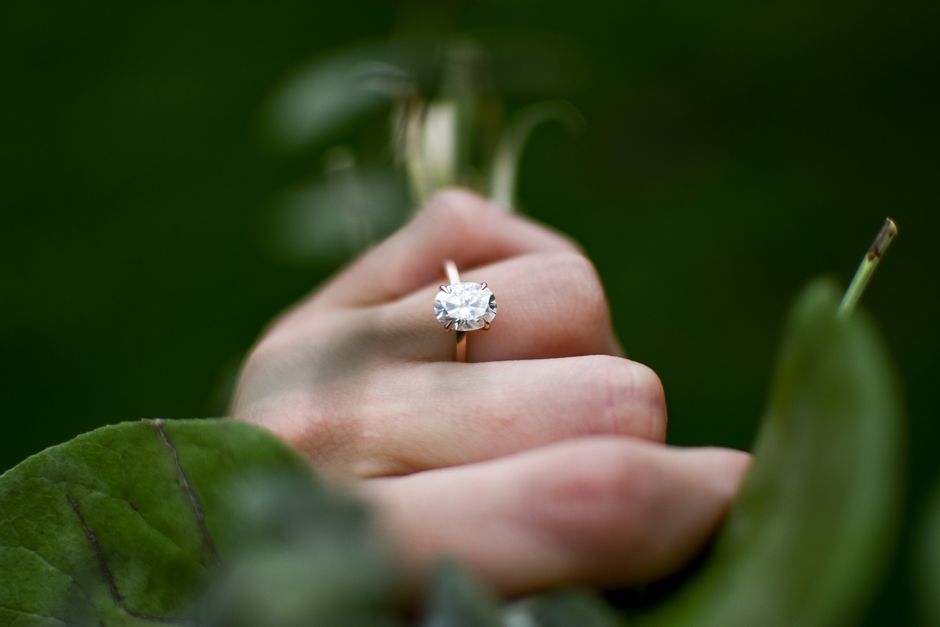
Before committing to a 3 carat ring, it is vital to understand how it actually behaves in the real world. A 3 carat round brilliant diamond measures approximately 9.3 mm to 9.4 mm across. To put that in perspective, its face-up surface area is roughly 108% larger than a standard 1 carat stone.
On an average size 6 finger, a 3 carat round diamond will cover approximately 60% of the finger's width. It is undeniably a showstopper. Elongated shapes, such as ovals or pear cuts, can look even larger, stretching down the finger to create an incredibly dramatic visual impact.
But is it practical for daily wear?
A 3 carat stone sits relatively high off the hand, meaning it is more prone to catching on clothing, scratching surfaces, or getting knocked during daily activities. If you have an active lifestyle, work with your hands, or frequently wear knitwear and gloves (a common reality during our beautiful Atlantic Canadian winters!), you will need to consider the practical design of the ring. Choosing a low-profile setting or a secure six-prong mount can provide the stability and safety needed to make a large stone wearable for everyday life.
Smart Buying Strategies to Maximize Your Budget
If you want to secure a breathtaking 3 carat ring without overpaying, we recommend employing a few insider buying strategies:
- Buy "Under-Size": Diamond prices jump significantly at round, whole-number thresholds (like 3.00 carats). If you search for a diamond that weighs 2.90 to 2.99 carats, you can save 10% to 15% on the price. Visually, a 2.95 carat diamond and a 3.00 carat diamond are completely indistinguishable to the naked eye, but the savings are very real.
- Drop a Color Grade: Don't pay a premium for a D, E, or F color diamond unless you are an absolute perfectionist. A G or H color diamond will look flawlessly white once set in a ring, saving you thousands of dollars that can be redirected toward a higher cut quality.
- Insist on an "Eye-Clean" VS2: Never buy a high clarity grade (like VVS1 or Flawless) just because of what it says on the paper. Instead, look for a VS2 or a carefully inspected SI1 diamond where the inclusions are located near the outer edges (girdle) of the stone, where they can easily be hidden by the setting's prongs.
- Combine Online Research with Local Trust: While online search tools are fantastic for comparing raw stone prices, nothing replaces seeing a large diamond in person under different lighting conditions. Working with a trusted local jeweler allows you to physically inspect the stone's fire and scintillation before making a major financial commitment.
Choosing the Right Certification and Retailer
When buying a diamond of this size, never buy uncertified. A minor grading discrepancy on a 3 carat stone can translate to a value difference of $10,000 or more.
Ensure your diamond is accompanied by a grading report from a highly respected, independent laboratory. For natural diamonds, the Gemological Institute of America (GIA) is the gold standard. For lab-grown diamonds, both the GIA and the International Gemological Institute (IGI) offer highly accurate, reliable grading reports. These certificates guarantee that the stone's color, clarity, and cut are exactly what the seller claims they are.
Additionally, always verify the retailer's return policy, warranty support, and resizing options. A reputable jeweler should offer a clear return window and professional in-house services to keep your investment secure.
Frequently Asked Questions About 3 Carat Diamond Rings
Is a 3 carat diamond too big for everyday wear?
It depends entirely on your personal style and daily routine. While some find a 9.3 mm stone too prominent for casual wear, others wear it daily with ease. To make a 3 carat stone practical, we recommend setting it in a low-profile mount that keeps the diamond closer to your finger, reducing the risk of snagging.
Why is there such a massive price gap between natural and lab-grown 3 carat diamonds?
The gap is driven entirely by supply and rarity. Natural diamonds require billions of years to form under the earth, and finding a rough crystal large enough to yield a clean 3 carat polished stone is extremely rare. Lab-grown diamonds, while physically identical, are grown in controlled laboratory environments. As technology has advanced, the cost of manufacturing has dropped, allowing these beautiful stones to be offered at highly accessible price points.
What is the best metal to pair with a 3 carat diamond?
Because a 3 carat diamond is a substantial gemstone, security is paramount. Platinum is the most durable choice for a large stone; it is a dense, strong metal that does not wear away over time, ensuring your prongs remain completely secure. If you prefer gold, we highly recommend opting for a platinum head (the prongs holding the diamond) paired with a yellow or rose gold band to combine the best of safety and style.
Conclusion
Whether you choose the timeless, geological romance of a natural stone or the brilliant modern value of a lab-grown alternative, purchasing a 3 carat diamond ring is an unforgettable milestone.
At Inglis Jewellers, we believe that buying a piece of jewelry this significant should be an exciting, transparent, and personalized experience. As a trusted Canadian retailer with deep roots in Atlantic Canada, we pride ourselves on offering expert craftsmanship and full-service goldsmithing support both online and across our showroom locations in Truro NS, New Glasgow NS, Sydney NS, and Riverview NB.
If you are ready to explore the stunning brilliance of a 3+ carat ring, our dedicated team is here to help you navigate the process, compare stones in person, or design a completely bespoke custom setting from scratch. Explore our curated brands and custom design services today, or visit us in-store to find your perfect sparkler!