


How Much Does a 2 Carat Diamond Ring Actually Cost in 2026?
The 2 carat diamond ring price in 2026 covers a surprisingly wide range — and knowing where you land depends on a few key factors.
Here's a quick snapshot:
| Type | Price Range (2026) |
|---|---|
| Natural 2ct (G, VS2, Excellent cut) | $15,000 – $26,000 |
| Natural 2ct (broad market range) | $4,000 – $30,000+ |
| Lab-grown 2ct (same specs) | $1,400 – $2,200 |
| Budget lab-grown 2ct | From ~$448 |
| Entry-level natural 2ct ring | From ~$3,800 |
A 2 carat diamond is not a small purchase. For most buyers, it's one of the biggest they'll ever make. Yet the price range is enormous — a $4,000 ring and a $30,000 ring can both be described as "2 carat diamond rings." The difference comes down to the stone's quality, its shape, how it's set, and where you buy it.
Understanding what drives that price gap is the difference between a confident purchase and a costly mistake.
What Determines a 2 Carat Diamond Ring Price?
When you begin searching for the perfect ring, it is easy to get overwhelmed by the numbers. Why does one ring cost the same as a reliable used car, while another costs as much as a down payment on a house in Nova Scotia?
To understand the 2 carat diamond ring price, you must first realize that diamonds are not priced on a linear scale. A 2 carat diamond does not simply cost double what a 1 carat diamond costs. Instead, diamond pricing is exponential. Because larger diamond crystals are significantly harder to find in nature, their price per carat skyrockets as the weight increases.
Rarity and Market Trends in 2026
In the natural diamond market, rarity is the ultimate price driver. While a 1 carat diamond is relatively common, a high-quality 2 carat natural diamond is a true geological marvel. Statistically, 2 carat diamonds are roughly 15 times scarcer than 1 carat stones.
According to the latest market data for June 2026, natural diamond prices have experienced some notable shifts. Over the last six months, natural diamond price indices have softened by roughly 10% to 14%, with 2 carat round diamonds seeing a very minor decrease of 0.01% over the last month alone. This stabilization means that for couples looking to invest in a natural stone, 2026 presents a highly opportunistic buying window.
At the same time, the price gap between natural and lab-grown stones has reached its widest point in history. For a deep dive into how these historical and modern pricing structures function, you can read more in this comprehensive 2026 Price Guide.
Average 2 Carat Diamond Ring Price in 2026
To help you visualize where your budget might take you, let's break down the realistic price spectrum for a complete 2 carat diamond ring.
| Diamond Quality & Type | Average Loose Stone Price | Average Ring Price (with 14K Gold Setting) |
|---|---|---|
|
Natural (Premium) D-F Color, VVS1-VS1, Excellent Cut |
$22,000 – $50,000+ | $23,500 – $52,000+ |
|
Natural (Sweet Spot) G-H Color, VS2-SI1, Excellent Cut |
$15,000 – $26,000 | $16,500 – $28,000 |
|
Natural (Budget/Inclusions) I-K Color, SI2-I1, Good Cut |
$4,788 – $9,500 | $6,000 – $11,000 |
|
Lab-Grown (Premium) D-F Color, VVS2-VS1, Ideal Cut |
$1,800 – $2,800 | $3,200 – $4,200 |
|
Lab-Grown (Sweet Spot) G-H Color, VS2, Ideal Cut |
$1,400 – $2,200 | $2,800 – $3,600 |
The Minimum Cost for a Beautiful Ring
While you can technically find natural 2 carat diamonds online for under $4,000, we strongly advise caution. A natural 2 carat diamond priced this low will almost certainly suffer from severe clarity issues (heavy, eye-visible black carbon spots) or a poor cut that leaves the stone looking dull, milky, or lifeless.
To get a 2 carat natural diamond ring that actually sparkles and looks beautiful on the hand, your starting budget should realistically begin around $3,800 to $5,000 for a lower-color, eye-clean SI2 stone, or about $1,400 if you choose a high-quality lab-grown diamond.
How Shape and Setting Affect the 2 Carat Diamond Ring Price
The diamond itself represents the largest portion of your budget, but the shape of that diamond and the metal holding it play massive roles in the final price tag.
Round Brilliant vs. Fancy Shapes
The round brilliant cut is the undisputed king of the diamond world, but it is also the most expensive. Why?
- Material Waste: Cutting a round brilliant diamond from a rough stone wastes up to 60% of the original crystal. Fancy shapes (like ovals, cushions, emeralds, and princess cuts) preserve far more of the rough diamond.
- High Demand: Round diamonds are the most popular shape globally, allowing wholesalers to command premium prices.
By choosing a "fancy shape," you can save a significant amount of money without sacrificing visual size. For example:
- Oval Cuts: Typically save you 15% to 20% compared to a round diamond, while actually appearing larger on the hand due to their elongated face-up surface area.
- Emerald and Cushion Cuts: Can save you up to 25% to 30% compared to a round brilliant of the exact same carat weight and quality.
Setting Styles and Metal Choices
Once you have selected your stone, you must choose its home. The setting can range from a simple, elegant solitaire to an intricate, custom-crafted masterpiece.
- Classic Solitaire: A simple four or six-prong band in 14K gold typically costs between $400 and $1,000. This is the most cost-effective option and keeps the focus entirely on your 2 carat stone.
- Pavé and Side-Stone Settings: Adding small diamonds along the band increases the ring's overall sparkle but adds $1,000 to $3,000 to the price due to the extra labor and gemstone costs.
- Halo Settings: Surrounding your 2 carat center stone with a circle of smaller diamonds can cost an extra $1,200 to $3,500. However, a halo can make your 2 carat stone look like a 3 carat giant from a distance.
- Metal Selection: 14K white or yellow gold is the most popular and durable choice for everyday wear. Platinum is the most luxurious option; it is naturally hypoallergenic and has a heavy, premium feel, but it will add a $500 to $1,500 premium over gold.
How the 4Cs Impact the Cost of a 2-Carat Stone
If you want to master the art of buying a diamond, you have to understand the 4Cs: Cut, Color, Clarity, and Carat weight. When dealing with a larger stone like a 2 carat diamond, minor changes in these grades can cause the price to swing by thousands of dollars.
To keep an eye on real-time market fluctuations across different grades, smart buyers often track the StoneAlgo Price Index.
Prioritizing Cut for Maximum Sparkle
If you take only one piece of advice from this guide, let it be this: Never compromise on the cut.
The cut is not the shape of the diamond; it is how well the diamond's facets interact with light. An Excellent or Ideal cut diamond will bend and reflect light beautifully, masking slight imperfections in color and clarity. Conversely, a poorly cut diamond will leak light out of the sides or bottom, leaving you with a dark, lifeless stone that looks smaller than its actual weight.
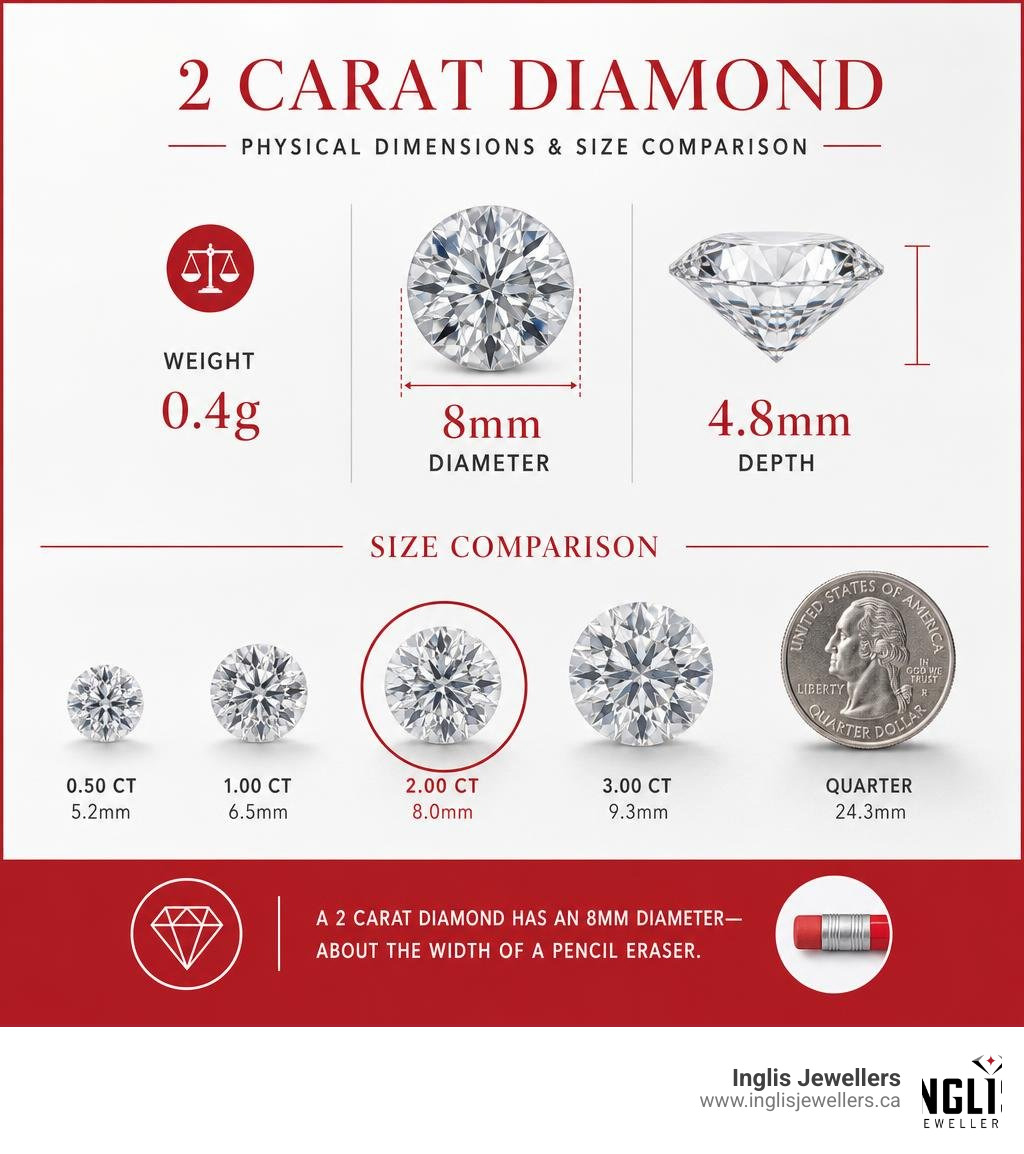
When a diamond is cut to ideal proportions, it also maximizes its "visual carat" size. This means the diamond is cut to have the perfect diameter-to-weight ratio, ensuring it looks like a true 2 carat stone (around 8.1mm to 8.2mm for a round brilliant) rather than being cut too deep, which hides the weight in the bottom of the ring where no one can see it.
Balancing Color and Clarity for Value
To get the absolute best value for your hard-earned money, you do not need to buy a flawless, perfectly colorless diamond. Instead, aim for the "sweet spot" where the diamond looks perfect to the naked eye, even if it has minor characteristics under a microscope.
[Flawless / Colorless]  --> Extremely Expensive (Paying for invisible perfection)
 |
[VS2-SI1 / G-H Color]   --> THE SWEET SPOT (Looks identical to the naked eye, saves 40%+)
 |
[I1-I2 / K-L Color] --> Budget Range (Inclusions and yellow tints visible to the eye)
Color: The "G-H" Sweet Spot
The GIA color scale runs from D (completely colorless) to Z (light yellow or brown).
- D-F (Colorless): Beautiful, but you will pay a massive premium for rarity.
- G-H (Near Colorless): This is the ultimate value sweet spot. When set in white gold or platinum, a G or H color diamond looks icy white to anyone looking at it. The tiny hint of warmth is completely invisible to the naked eye.
- I-J (Warm White): If you are setting your diamond in a yellow gold or rose gold band, you can safely drop to an I or J color. The yellow gold of the setting will naturally reflect through the stone, making a slightly warm diamond look perfectly white by comparison, saving you an extra 15% to 20%.
Clarity: The "VS2-SI1" Sweet Spot
Clarity measures the internal and external imperfections (inclusions and blemishes) of a diamond.
- FL-VVS2 (Flawless to Very, Very Slightly Included): These diamonds are incredibly rare and clean under 10x magnification, but they carry a hefty price tag.
- VS2-SI1 (Very Slightly to Slightly Included): In this range, the vast majority of diamonds are "eye-clean." This means that while a professional jeweler can see the inclusions under a microscope, you cannot see them with the naked eye. Choosing an eye-clean SI1 diamond can save you up to 50% compared to a Flawless stone of the same size.
Natural vs. Lab-Grown: The Ultimate Price Comparison
One of the biggest decisions you will make when pricing out a 2 carat diamond ring is choosing between a natural mined diamond and a modern lab-grown alternative.
The Science
First, let's clear up a common misconception: lab-grown diamonds are real diamonds. They are not cubic zirconia or moissanite. They are chemically, physically, and optically identical to natural diamonds. They have the exact same hardness (10 on the Mohs scale), the same refractive index, and the same breathtaking sparkle.
The only difference is their origin. A natural diamond is forged by intense heat and pressure deep within the Earth over billions of years. A lab-grown diamond is grown in a high-tech laboratory over a few weeks using advanced methods that mimic the Earth's natural process.
The Price Difference
Because lab-grown diamonds do not require expensive mining operations and have a highly efficient supply chain, they are significantly less expensive to produce.
In 2026, a top-tier natural 2 carat diamond (G color, VS2 clarity, Excellent cut) will cost you anywhere from $15,000 to $26,000.
A lab-grown diamond with the exact same specifications costs between $1,400 and $2,200 — representing a massive 90% savings. This price difference allows couples to either save thousands of dollars for other life goals (like a home down payment or an unforgettable honeymoon) or dramatically increase the size of the diamond they can afford.
Value Retention and Ethical Sourcing
While lab-grown diamonds offer incredible upfront savings, it is important to understand how they behave as an asset:
- Natural Diamonds: Hold resale value over time due to their finite supply. They are viewed as heirloom investments that can be passed down through generations.
- Lab-Grown Diamonds: Have very little to no resale value because technology continues to make them easier and cheaper to produce.
- Sourcing: Lab-grown diamonds are often favored by eco-conscious buyers because they have a minimal environmental footprint compared to traditional open-pit mining.
Smart Ways to Save on Your 2-Carat Engagement Ring
If you have your heart set on a stunning 2 carat ring but want to keep your bank account happy, here are our favorite insider secrets to maximize your budget.
1. The "Magic Weight" Strategy
Diamond prices jump drastically at round numbers like 1.00 ct, 1.50 ct, and especially 2.00 ct. These are known in the industry as "magic weights."
To save a bundle, look for a diamond that weighs just under the threshold — specifically between 1.90 and 1.99 carats. Because these stones missed the prestigious "2.00" mark on the scale, their price per carat is significantly lower. Visually, a 1.95 carat diamond and a 2.00 carat diamond are completely indistinguishable to the human eye, but choosing the 1.95ct stone can easily save you 10% to 15% on the spot.
2. Embrace Elongated Fancy Cuts
As mentioned earlier, fancy shapes like ovals, marquise, and pear cuts are not only cheaper per carat than round brilliants, but they also have a larger surface area. An oval diamond distributes its weight across a longer footprint, meaning a 1.80 carat oval diamond often looks visually larger than a 2.00 carat round diamond, giving you a massive visual impact for a fraction of the price.
3. Choose a Local, Trusted Jeweller
While massive corporate online retailers promise the lowest prices, they often lack the personal touch, custom design expertise, and lifetime maintenance services that keep your ring looking spectacular for decades.
By working with a trusted local jeweler in Atlantic Canada, you get direct access to expert goldsmiths who can help you source the perfect loose stone, design a custom setting that maximizes the diamond's beauty, and provide in-store cleanings, sizings, and inspections to protect your investment.
Frequently Asked Questions about 2 Carat Diamond Rings
How big is a 2 carat diamond on a hand?
A 2 carat round brilliant diamond has an average diameter of approximately 8.1mm to 8.2mm. To put that in perspective, a standard 1 carat round diamond is about 6.4mm wide.
On a typical size 6 finger, an 8mm diamond will cover roughly 50% of the width of the finger, creating a striking, luxurious presence that is highly visible without looking overly gaudy.
Is a 2 carat diamond too big for everyday wear?
Not at all! A 2 carat diamond is a wonderful size for daily wear, but it does require a secure setting to protect your investment.
Because a 2 carat stone sits higher off the finger than smaller stones, it is more prone to knocking against car doors, countertops, and desks. To keep it safe, we recommend choosing a sturdy six-prong setting (which provides extra security over a four-prong setting) or a sleek bezel setting, which wraps a protective metal collar entirely around the edge of the diamond.
Why does a 2 carat diamond cost more than double a 1 carat diamond?
It all comes down to natural scarcity. In the earth, finding a rough diamond crystal large enough to be cut into a finished 2 carat gem is incredibly rare.
Because the supply of these larger crystals is so limited, the price curve is exponential. When you buy a 2 carat diamond, you are not just buying twice as much diamond weight; you are buying an item that is exponentially scarcer in nature, which is reflected in the premium price per carat.
Conclusion
Finding the perfect 2 carat diamond ring is a beautiful journey of balancing your personal style, values, and budget. Whether you fall in love with the classic allure and lasting value of a natural mined diamond or prefer the incredible affordability and modern engineering of a lab-grown stone, the key to a successful purchase is working with a partner you can trust.
At Inglis Jewellers, we have spent decades helping couples across Atlantic Canada find and design their dream engagement rings. With full-service jewelry stores and expert on-site goldsmiths in Truro, NS, New Glasgow, NS, Sydney, NS, and Riverview, NB, we provide the personalized, warm, and honest guidance you deserve.
Ready to begin your search? Let our family help yours. Come visit us in-store or Explore our curated brands online today to find a ring that will tell your love story beautifully for generations to come.